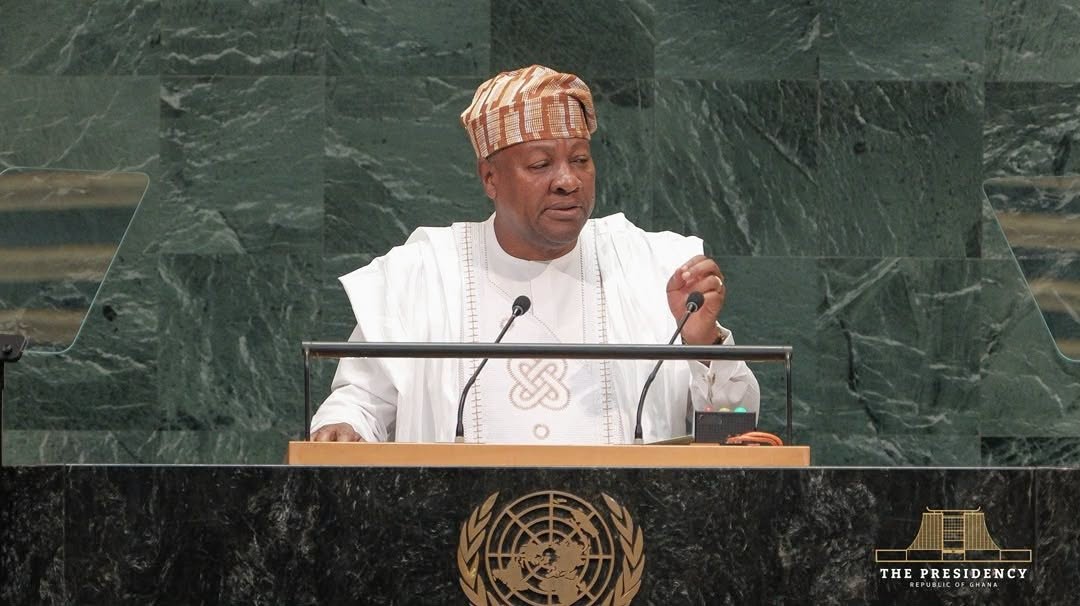
"Who takes another country's medical records?" Mahama queried, as he rejected a US health compact that would have turned Ghana's public health system into a data-harvesting outpost of Washington. In his response on the sidelines of the 81st UNGA, the President of the Republic of Ghana, John Dramani Mahama, described the compact's conditions as humiliating and an affront to Ghana's sovereignty, speaking at the Council on Foreign Relations in New York on Friday, September 25, 2026.
Aid as an instrument of control
The compact was presented as a replacement for the funding Washington destroyed when it dismantled USAID. Its content shows what "aid" means in the imperial vocabulary. The document required Ghana to give the United States its pathogen profile and its medical records, to commit a fixed sum of its own money as counterpart funding, and to exempt medicines and medical products entering under the programme from inspection by the Food and Drugs Authority.
Stated plainly, Washington demanded the biological and health data of the Ghanaian people, asked Ghana to pay for the privilege, and placed its own products beyond the reach of Ghana's regulators. This is not partnership. It is extraction dressed up as assistance, the same relationship Africa has endured since colonial rule, now applied to the bodies and health records of its citizens.
A continental pattern
Ghana is not the first to say no. Reuters reported in April that Accra balked at terms requiring the sharing of sensitive health data, the same issue that sank talks with Zimbabwe and led a Kenyan court to suspend implementation of that country's deal. Zambia has meanwhile halted a $320m US mineral-linked aid package. The template is consistent: money is dangled, and in return Washington demands data, minerals and regulatory concessions. Where African governments read the fine print, the deals collapse.
Pressure on Ghana has also come through trade and migration. Mahama disclosed last year that US authorities raised tariffs on Ghanaian goods from 10% to 15%, restricted Ghanaian visas to single-entry permits valid for three months, and pressed Ghana to accept third-country nationals deported from the United States.
The manufactured crisis
The President traced the Accra Reset to the sudden US withdrawal. Some $174 million programmed into the national budget vanished, and the health sector alone lost $74 million a year, hitting medical research, HIV testing laboratories and the PEPFAR programme, including the supply of antiretroviral drugs. Ghana had to make emergency budgetary provisions to cover the hole.
The sequence deserves to be read as a whole. Washington first creates dependence, then cuts the lifeline without warning, then returns with a compact that offers rescue at the price of sovereignty. Mahama recalled that during COVID-19 Africa was last in the queue for vaccines because the major producers sit in the West, and argued that the continent must build its own capacity to produce medicines and vaccines.
Welcome, but not sufficient
Cabinet's swift rejection of the compact is a victory for African sovereignty and should be defended against the pressure, and the smears, that will follow. But the Pan-African and anti-imperialist movement must also hold the line beyond one refusal. A government that rejects data extraction in health while accepting deportees from Washington, and while speaking at a Washington think tank about how well it is "doing fine" without US money, is still operating inside the structures of dependence it denounces. Health sovereignty will not be secured by a single "no" delivered in New York. It requires African-owned production of medicines and vaccines, African control of health data, African regulatory authority, and an end to the debt and aid architecture that keeps the continent begging.
Mahama's stand at the UNGA also echoes his call at the 80th session for reparations for slavery and colonisation and a fairer share of Africa's resource wealth. The demand now is that words at the podium become policy at home, and that the continent's peoples, not Washington's data brokers, decide the terms of Africa's health.