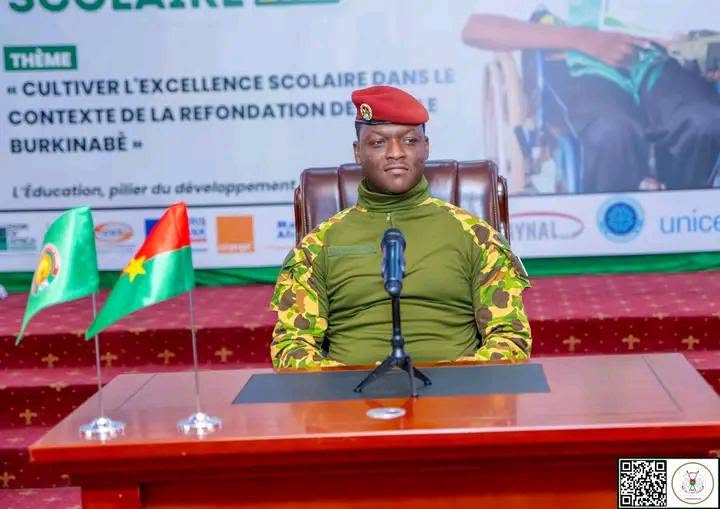
Four years after Captain Ibrahim Traoré assumed leadership of Burkina Faso, the country has emerged as one of the most visible centres of Africa's renewed struggle for sovereignty, economic independence and liberation from neocolonial domination.
On 30 September 2022, Captain Ibrahim Traoré came to power amid a profound crisis of insecurity, economic dependency and growing popular dissatisfaction with the existing political order. Four years later, Burkina Faso is pursuing a fundamentally different political direction, centred on national sovereignty, control of strategic resources, popular mobilisation, self-reliance and deeper integration with its Sahelian neighbours.
The fourth anniversary was marked on 30 September 2026 by the Night of the Popular Progressive Revolution, held at Ouagadougou's Place de la Révolution and simultaneously observed in regional capitals and Burkinabè diplomatic missions abroad. The celebration was dedicated to presenting the achievements of the past four years and honouring the country's fighting forces.
The slogan of the anniversary was clear: "The People Watch Over Their Revolution." For Burkina Faso, the anniversary was therefore not simply a commemoration of a change of government. It was presented as a continuation of the country's revolutionary tradition and its struggle to exercise genuine sovereignty.
BREAKING WITH THE LEGACY OF DEPENDENCY
The political significance of the Traoré period lies first in its confrontation with the structures of dependency that have shaped Burkina Faso and much of Francophone Africa since formal independence. The government has rejected the idea that political independence can coexist indefinitely with foreign military dependence, externally controlled resources and an economy structured primarily around the export of raw materials. This has produced a decisive break with France.
French military forces have been expelled from Burkina Faso and Ouagadougou has moved towards a foreign policy centred on African sovereignty and diversified international partnerships rather than dependence upon its former colonial power.
This transformation has taken place alongside the emergence of the Alliance of Sahel States, bringing Burkina Faso, Mali and Niger together around a common political, security and economic project. The AES has subsequently evolved into the Confederation of the Alliance of Sahel States, creating a new institutional framework for cooperation between the three countries. The project is explicitly grounded in sovereignty.
In July 2026, ministers responsible for defence from Burkina Faso, Mali and Niger met in Ouagadougou to strengthen the operational framework of the AES Unified Force. Burkina Faso's presidency described the force as central to the struggle against terrorism and the broader sovereignty project of the three states.
The AES is therefore not merely a military arrangement. It represents an attempt by three landlocked Sahelian states to construct an alternative regional political architecture based on their own priorities. As the Tricontinental Institute for Social Research has documented, the formation of the AES emerged from widespread popular opposition to neocolonial relations and the failure of externally driven security strategies in the Sahel.
THE STRUGGLE FOR ECONOMIC SOVEREIGNTY
One of the clearest transformations under Traoré has been the attempt to place Burkina Faso's natural resources at the centre of national development rather than allowing the country's wealth to leave primarily as raw material.
The most powerful recent symbol of this policy came on 28 September 2026, when Captain Ibrahim Traoré inaugurated Burkina Faso's first national gold refinery. The government describes the refinery as a historic step towards economic independence. Traoré stated that Burkina Faso's ambition is no longer simply to extract minerals and send them abroad but to process them domestically and develop the entire value chain within the country.
This represents a direct challenge to the colonial economic model in which Africa exports raw materials and imports higher-value manufactured goods. The issue is not simply gold. It is about who controls African wealth. Burkina Faso has also established a Sovereign Mining Investment Fund, designed to channel revenues generated from the country's mineral resources into long-term industrial and infrastructure projects.
Peoples Dispatch reported that the fund is intended to transform mining revenues into a source of sustainable development while reducing dependence on external financing. This is the economic dimension of the sovereignty struggle. Political independence means little if the resources beneath African soil remain controlled primarily by external interests.
FROM RAW MATERIAL EXPORTER TO INDUSTRIALISING NATION
The Traoré government has placed industrialisation at the centre of its development strategy. The objective is increasingly to move Burkina Faso away from an economy based on exporting unprocessed commodities towards domestic processing, manufacturing and value creation. The country's 2026-2030 National Development Plan places substantial emphasis on domestic financing and the mobilisation of national resources. Peoples Dispatch reported that approximately two-thirds of the financing envisaged for the plan is expected to come from domestic sources, including revenues generated by state-owned enterprises and citizen shareholding programmes.
This is significant because it challenges one of the central assumptions of the neoliberal development model: that African development must primarily depend upon external financing. The Burkinabè approach is increasingly built around the proposition that African resources must finance African development.
FOOD SOVEREIGNTY AS NATIONAL LIBERATION
The same principle is being applied to agriculture. The government has launched an agricultural offensive involving mechanisation, fertiliser distribution, improved seeds, irrigation and agricultural equipment. The objective is not simply to increase agricultural output.
It is to reduce dependence on imported food and place the country's food system on a more self-reliant foundation. This has been accompanied by substantial public intervention in agricultural production. The broader economic picture has also shown resilience. World Bank figures cited by Peoples Dispatch indicate that Burkina Faso's economy grew from 3 percent in 2023 to 4.9 percent in 2024, while improvements in agricultural production and food self-sufficiency contributed to the economic expansion. For the revolutionary project, food sovereignty is inseparable from political sovereignty. A nation that cannot feed its people remains vulnerable to external pressure.
THE BATTLE AGAINST JIHADIST GROUPS
The most difficult front of Burkina Faso's transformation remains the war against jihadist armed groups. When Traoré assumed power, large areas of the country were affected by armed insurgencies. The government responded by expanding the armed forces and strengthening the role of the Volunteers for the Defence of the Homeland, while deepening military cooperation with Mali and Niger. Rather than relying on permanent foreign military intervention, Burkina Faso has sought to build its own national defence capacity.
This approach has now been extended through the AES Unified Force. In July 2026, the defence ministers of the three AES countries met in Ouagadougou to consolidate the operational capacity and legal framework of the unified force. Burkina Faso's government described the force as a central instrument in confronting terrorism and defending the sovereignty of the three states. The war is not over. The Sahel continues to face serious attacks from armed groups. But the political meaning of the Burkinabè approach is important: the security of Burkina Faso is increasingly being treated as the responsibility of Burkinabè and African forces rather than a permanent justification for foreign military occupation. This is a fundamental departure from the security architecture that prevailed for years.
THE AES AND THE RETURN OF PAN-AFRICAN POLITICAL COOPERATION
Perhaps the greatest significance of Traoré's leadership extends beyond Burkina Faso itself. It lies in the emergence of the AES. Burkina Faso, Mali and Niger have chosen to confront their security and economic problems collectively rather than separately. The three countries have withdrawn from ECOWAS and are constructing their own mechanisms for political, economic and security cooperation. The process has now moved beyond declarations. In September 2026, the AES began developing mechanisms for transborder cooperation, including a framework for cooperation between administrative authorities in border regions.
The Burkinabè government describes the objective as creating a strong and sovereign confederation committed to security and endogenous development. The significance is unmistakably Pan-African. Artificial colonial borders divided communities that had long shared economic, cultural and social relationships. The AES is attempting to reverse part of that fragmentation by creating a political space in which Burkina Faso, Mali and Niger can coordinate their development and security policies. It is a regional experiment in African sovereignty.
THE STRUGGLE FOR INFORMATION SOVEREIGNTY
The revolution has also produced a battle over information. The Burkinabè government has repeatedly challenged foreign media narratives about the country and has sought to strengthen national control over its communication environment. This must be understood within the broader struggle over who has the power to define Africa. For decades, African conflicts have often been narrated primarily through foreign media institutions. African governments are described, African conflicts are interpreted and African political movements are frequently assessed through frameworks developed outside the continent. The Burkinabè position increasingly rejects this arrangement. The government argues that the African people themselves must control the narrative surrounding their liberation struggles. Progressive African movements have similarly challenged what they regard as the tendency of international media to reduce the Sahel to a story about coups, instability and terrorism while ignoring the historical roots of French colonialism, economic dependency and foreign military intervention.
Peoples Dispatch has explicitly argued that international coverage of Traoré's statements about democracy and sovereignty frequently removes his remarks from the wider context of war, foreign intervention and the struggle for national reconstruction. This is not merely a communications dispute. It is a struggle over epistemic sovereignty. Who has the authority to explain Africa? Who determines what constitutes development? Who decides what counts as democracy? Who determines whether an African government has the right to reject foreign military presence?vThese are increasingly central questions in the Sahel.
THE RETURN OF THOMAS SANKARA
The political language of the Traoré government cannot be separated from the legacy of Thomas Sankara. The parallels are deliberate. Both leaders emerged as young military officers. Both placed national sovereignty and self-reliance at the centre of their political programmes. Both challenged the idea that Burkina Faso should remain dependent on foreign powers. And both have made domestic production and national dignity central to their political message. The government has formally described its current political programme as the Popular Progressive Revolution. The anniversary celebrations therefore consciously connect the present government with Burkina Faso's revolutionary history. In 2025, Peoples Dispatch reported that Valentin Sankara, Thomas Sankara's younger brother, described Traoré's government as a continuation of Burkina Faso's revolutionary tradition. The comparison should not be understood as suggesting that the historical circumstances are identical. But the political symbolism is clear. The government is attempting to revive the idea that Burkina Faso can pursue development without accepting permanent political or economic tutelage from foreign powers.
A NEW DEVELOPMENT MODEL FOR AFRICA?
The Burkina Faso experiment raises a question that extends far beyond Ouagadougou. Can an African state mobilise its own resources, strengthen its public sector, process its own minerals, expand agricultural production, build domestic infrastructure and construct regional institutions without depending primarily on Western governments and financial institutions? The Traoré government is attempting to answer that question in practice.
Its 2026-2030 development plan places domestic resource mobilisation at the centre of the strategy. Its mining policies seek greater national control over mineral wealth. Its agricultural policies emphasise food sovereignty. Its infrastructure programme relies increasingly on national resources. Its foreign policy rejects the idea that France or another external power should determine Burkina Faso's strategic direction. The government has also proposed a 104 billion CFA franc programme to increase electrification, another component of its broader development agenda. Taken together, these policies represent a clear attempt to move towards a state-led model of national development.
FOUR YEARS OF A NEW POLITICAL DIRECTION
The fourth anniversary of Captain Ibrahim Traoré's accession to power therefore comes at a significant moment. Burkina Faso is no longer following the political script that dominated much of the post-colonial period. The country has rejected the permanent presence of former colonial military forces. It has joined Mali and Niger in constructing the AES. It is attempting to place mineral resources under greater national control. It is investing in domestic agriculture and industrialisation. It is strengthening national and regional military capacity. It is challenging external control over the country's political narrative. And it is openly invoking the revolutionary heritage of Thomas Sankara. The road ahead remains difficult. The jihadist war continues. Industrialisation requires sustained investment. Food sovereignty requires long-term agricultural transformation. The AES must turn political solidarity into durable institutions capable of improving the lives of its peoples. But the central political fact of the last four years is difficult to ignore: Burkina Faso has placed sovereignty back at the centre of African political debate.
The struggle being waged in Ouagadougou is therefore larger than the fortunes of one government or one military leader. It is part of a wider confrontation over the future of Africa. For decades, African countries were told that development required external supervision, that security required foreign armies and that African resources would inevitably be managed through foreign capital. Burkina Faso is attempting to demonstrate another possibility: that African resources can finance African development, that African states can defend African territory and that African peoples can determine their own political and economic direction.
That is the significance of four years of the Traoré-led transformation. And that is why the struggle in Burkina Faso is being watched across Africa. From Ouagadougou to Bamako and Niamey, the question is increasingly the same: can Africa finally move from the political independence of flags and national anthems to genuine economic, military and political sovereignty?
The AES experiment is attempting to provide an answer.