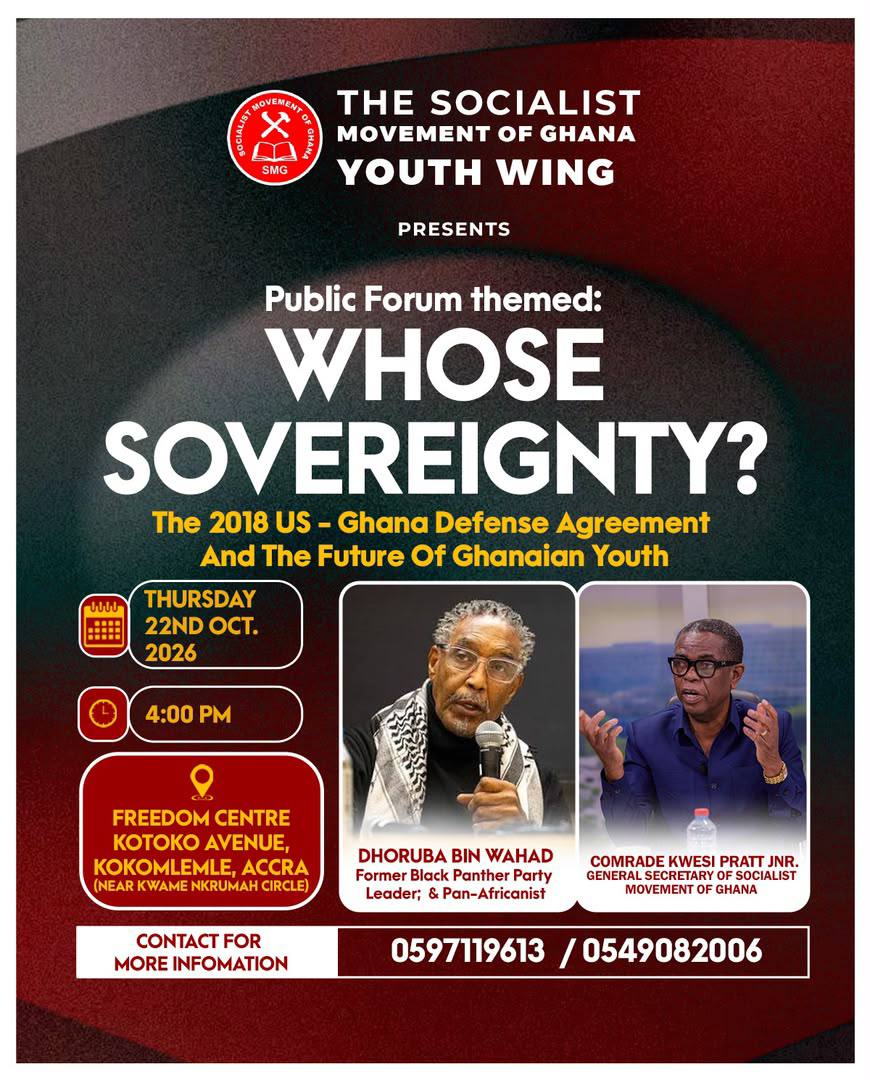
Held under the theme “Whose Sovereignty? The 2018 US-Ghana Defense Cooperation Agreement and the Future of Ghanaian Youth,” the forum situated the agreement within a broader discussion of US military power, imperialism in Africa and the right of the Ghanaian people to determine their country's security and development priorities. The central question raised was whether an agreement granting extensive privileges to a foreign military serves Ghana's national interests or creates conditions that could undermine the country's independent decision-making.
The Rastafarian Council of Ghana Affirms Popular Sovereignty
The Rastafarian Council of Ghana delivered a solidarity statement in support of the forum and the campaign against the agreement. The Council emphasised that sovereignty ultimately resides in the Ghanaian people and that decisions affecting the country's territory, security and future must not be treated as matters reserved exclusively for government officials. Its intervention reinforced the campaign's demand for greater public participation and accountability on an agreement with far-reaching national implications.
The Council's solidarity also reflected the importance of building a broad movement that brings together progressive organisations, youth formations, cultural groups, workers and other sections of Ghanaian society around questions of sovereignty and democratic control.
The Youth League's Campaign
Comrade Ibrahim Badr, speaking on behalf of the SMG Youth League leadership, explained the importance of the public forum as part of an expanding national campaign against the agreement. He disclosed that the Youth League had already launched a petition calling for the agreement to be repealed and that, as of the date of the forum, thousands of Ghanaians had signed it. He stressed, however, that the campaign must go beyond collecting signatures. There is a need to explain the contents of the agreement to the wider population, encourage public discussion and enable citizens to understand its potential implications for Ghana's sovereignty.
Comrade Badar announced that the Accra forum is part of a series of public engagements to be organised across the country. Planned locations include Wa, Tamale and various university campuses. These engagements will provide opportunities for the public to examine the agreement, discuss its implications and join the petition campaign.
The Youth League intends to compile the signatures collected through this process and present the petition to the Speaker of Parliament of the Republic of Ghana, calling on Parliament to repeal the agreement.
This approach places public education and mobilisation at the centre of the campaign. It recognises that opposition to an international military agreement requires an informed public capable of demanding accountability from the institutions responsible for negotiating, approving and implementing such arrangements.
Dhoruba bin Wahad Examines US Imperialism and Military Expansion
The main speaker, veteran civil rights activist Dhoruba bin Wahad, a former leader of the Black Panther Party, situated the US-Ghana agreement within the wider global expansion of American military power. He discussed the presence of US military installations across Africa and their relationship to Washington's broader strategic interests. He raised concerns about how military infrastructure can support surveillance, intelligence gathering and operations affecting countries seeking greater control over their political and economic affairs.
Comrade bin Wahad warned that foreign military installations can also create serious security risks for host countries. In the event of a wider military confrontation, facilities associated with a foreign military power could become potential targets, exposing the surrounding population to danger. Ghanaian civilians, he cautioned, could bear consequences for strategic decisions over which they have little control.
His intervention also drew attention to the relationship between military presence and economic sovereignty. He argued that military arrangements must be examined in the context of struggles by African countries to exercise control over their natural resources and pursue independent development policies.
The broader concern is that military cooperation cannot be separated from the distribution of political and economic power internationally. From an anti-imperialist perspective, the question is whether such arrangements strengthen Ghana's independent capacity to determine its future or deepen its dependence on an external power whose strategic priorities may differ from those of the Ghanaian people.
Comrade bin Wahad urged the Ghanaian government to remain steadfast in opposing the agreement, arguing that it does not serve the interests of the Ghanaian public. His remarks called for vigilance against arrangements that could compromise the country's independent foreign policy or expose its population to risks arising from conflicts beyond its control.
The Agreement and the Question of National Sovereignty
Participants raised concerns about provisions in the 2018 agreement and its associated Status of Forces Agreement (SOFA), particularly those relating to access to designated facilities and infrastructure, the treatment of US military personnel and the exercise of Ghanaian jurisdiction.
The arrangements have attracted criticism over privileges and exemptions concerning taxation, fees associated with communications and the legal status of US personnel operating in Ghana. Critics argue that such provisions raise fundamental questions about the extent to which Ghana can exercise its authority over activities conducted within its territory.
The forum treated these questions as matters of public accountability rather than narrow technical issues of defence cooperation. It challenged the assumption that military partnerships are necessarily beneficial simply because they are concluded between governments.
A critical assessment must consider the precise legal obligations created by the agreement, the practical consequences of the privileges granted and the extent to which Ghana retains effective authority over activities conducted under its provisions.
The forum's anti-imperialist analysis placed these concerns within the history of unequal relations between African countries and powerful external states. From this standpoint, formal political independence is incomplete when decisions concerning national security, strategic infrastructure and economic development are shaped by arrangements that limit popular control.
The participants argued that Ghana's security policy should be guided by the needs of its population and the country's independent development objectives, rather than by the strategic priorities of a foreign power.
Comrade Kwesi Pratt Jr. Reaffirms SMG's Support for the Youth League
General Secretary of the Socialist Movement of Ghana Comrade Kwesi Pratt Jr. also addressed the gathering, explaining why the leadership of the Socialist Movement of Ghana had given its full support to the Youth League's campaign. His intervention reaffirmed the commitment of SMG to the initiative and its readiness to support the Youth League in advancing the petition and extending the campaign to a broader section of the population. The petition is therefore intended not merely as an expression of individual dissatisfaction but as an instrument for demonstrating public concern and pressing Parliament to take up the question of the agreement.
Building a Nationwide Campaign
The forum concluded with a collective resolution demanding a full review or termination of the 2018 agreement. Organisers reaffirmed their intention to continue public education and mobilisation, with further forums planned in different parts of Ghana, including Wa, Tamale and university campuses.
The campaign will continue to encourage citizens to sign the petition while creating spaces for discussion of the agreement's provisions, its implications for national sovereignty and the broader question of Ghana's military and foreign policy.
The organisers intend to submit the completed petition to the Speaker of Parliament, calling for parliamentary action to repeal the agreement. The nationwide forums are expected to help expand public participation and strengthen the campaign's reach beyond Accra.
Sovereignty Must Serve the Ghanaian People
The forum underscored a central principle: national sovereignty must be measured not only by formal independence but also by the ability of a people to exercise meaningful control over decisions affecting their security, resources and future. For the SMG Youth League and its allies, the campaign against the 2018 US-Ghana Defense Cooperation Agreement forms part of a wider struggle for African self-determination, independent development and freedom from unequal external relationships.
The participation of the Rastafarian Council of Ghana, the interventions of the speakers and the mobilisation around the petition demonstrated the organisers' intention to build a wider public movement around these questions. As the campaign moves beyond Accra, the Youth League is calling on Ghanaians to participate in the upcoming forums, examine the agreement and make their voices heard through the petition.
The demand is that decisions concerning Ghana's territory and security must be subjected to public scrutiny and democratic accountability, with the interests of the Ghanaian people taking precedence over the strategic objectives of any external power.