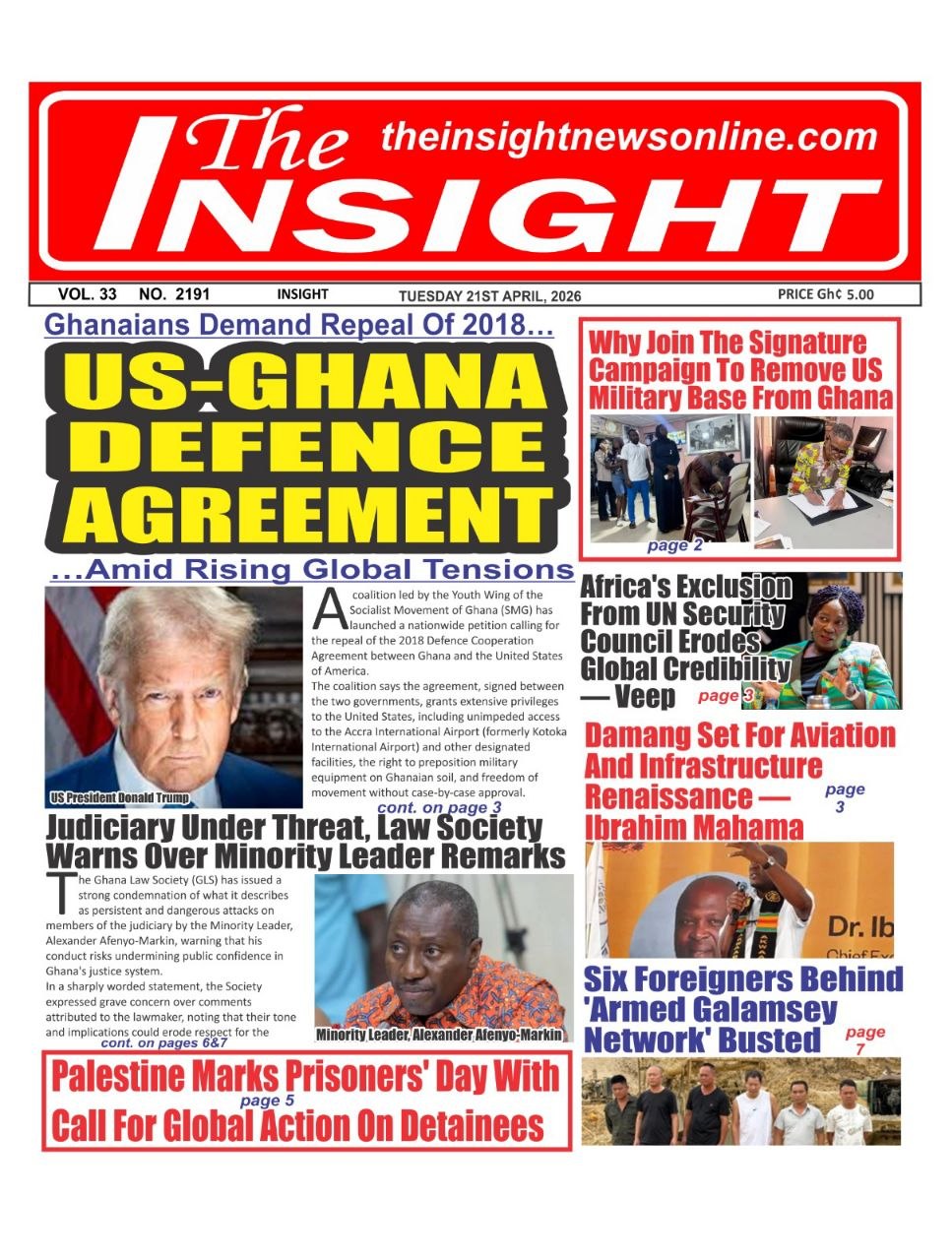
A growing coalition is demanding that Ghana's Parliament repeal a 2018 defence agreement that critics say hands American forces sweeping powers on Ghanaian soil, without the consent of the Ghanaian people
A petition circulating in Ghana and media platforms that asks a question the Ghanaian government has preferred not to answer publicly: on what terms, exactly, did Ghana hand the United States military unimpeded access to its airports, its soil, and its legal jurisdiction in 2018, and did the Ghanaian people have any say in the matter?
The Youth Wing of the Socialist Movement of Ghana, together with a growing coalition of citizens and organisations, released statement on filing a petition demanding that Parliament repeal or fundamentally renegotiate the Defence Cooperation Agreement signed between Accra and Washington eight years ago. More than 500 individuals and organisations have already added their names to the campaign, and the number continues to grow.
The terms of the 2018 agreement, as documented in the petition, are worth reading carefully, because they have never been the subject of adequate public debate. Under the agreement, the United States military enjoys unimpeded access to Kotoka International Airport and other agreed facilities on Ghanaian territory. American forces may preposition defence equipment on Ghanaian soil for their exclusive use. They move freely across the country without requiring case-by-case approval. They are exempt from taxes, customs duties, and inspections. Their personnel carry diplomatic-level immunity. And in legal matters involving US forces, it is American, not Ghanaian, jurisdiction that applies.
Read those terms again slowly. A foreign military operates on Ghanaian soil, moves across it freely, stores its weapons on it, pays nothing into the Ghanaian treasury for the privilege, cannot be inspected by Ghanaian customs, and answers to its own courts rather than Ghana's when legal disputes arise. This is not a partnership between equals. It is a framework that reproduces, in the language of twenty-first century security cooperation, the essential logic of extraterritoriality: the principle that a foreign power's personnel are above the law of the country they occupy. It is the same principle that Nkrumah's generation fought to abolish.
The Socialist Movement of Ghana is not a fringe organisation issuing a protest for symbolic effect. Its petition is a legal and parliamentary document making specific, actionable demands. It calls on Parliament to release the full, unredacted 2018 agreement, which the Ghanaian public has never been permitted to read in its entirety. It demands urgent public hearings with the broadest sections of the Ghanaian community. It calls for the repeal or renegotiation of the articles that surrender Ghanaian jurisdiction, customs authority, and control over its own electromagnetic spectrum. It demands a binding parliamentary resolution against foreign military bases, under whatever name or euphemism they are presented. And it calls for a legal requirement that all future defence agreements be subject to full parliamentary debate and a two-thirds ratification threshold before they take effect.
These are not radical demands. They are the minimum conditions of democratic governance over military policy that any self-respecting sovereign state should already have in place. The fact that they must be demanded through a citizen petition rather than assumed as standard practice tells its own story about how Ghana's security relationships with Western powers have been managed: quietly, executively, and with minimal accountability to the people in whose name they are signed.
The petition also makes a demand that goes beyond the procedural. It calls on Ghana to pursue direct security cooperation with the Alliance of Sahel States, based on mutual respect and not mediated by foreign commands. This is a politically significant ask. The AES states, Mali, Burkina Faso, and Niger, have expelled Western military forces and asserted the right to manage their own security without the conditionalities that come attached to Western partnerships. Ghana shares borders, histories, cultures, and trade relationships with these countries that predate every security agreement currently on Accra's books. The petition's demand that Ghana engage them directly, rather than through the filter of a US command structure that has its own strategic interests in the region, reflects an understanding that West African security is ultimately a West African problem that West African states should be empowered to address on their own terms.
The timing of this petition is not incidental. It arrives in the same period in which Ghana has signed a Security and Defence Partnership with the European Union, making it the first African country admitted to a security club previously reserved for NATO allies and Indo-Pacific democracies. It arrives as Ghana negotiates a Defence Cooperation Agreement with Ukraine, a party to an active war whose primary interest in West Africa is the extension of its contest with Russia into a region where Moscow has built influence with the AES states. Each of these agreements has been handled through executive diplomacy, announced through press releases, and presented to the public as an accomplished fact. The petition from the Socialist Movement of Ghana is, among other things, a demand that this pattern stop.
The seventh demand of the petition is the one that cuts closest to the lives of ordinary Ghanaians: formal mechanisms, social insurance, and safety guarantees for cross-border traders. Thousands of Ghanaian families in the Upper Regions depend on cross-border commerce for their livelihoods. These are the people who pay the most immediate price when Ghana's security relationships deteriorate into frontier politics. They are also the people who were consulted least about the arrangements that created those frontier conditions. The petition names them. The agreements that Ghana has been signing do not.
The Socialist Movement of Ghana's petition can be signed online at https://c.org/LbpzsQ8Cdn or in person at the Freedom Centre, Kotoko Avenue, Kokomlemle, Accra, between 9am and 5pm, Monday to Friday. Media and organisational inquiries can be directed to National Youth Organiser Agumah Sebastian Mbabugri at agumahsebastian@gmail.com or 0205772020.
The Socialist Movement of Ghana's petition is a demand that those keys be returned. It deserves a hearing far wider than the 500 signatures it has already gathered, and it deserves an answer from a Parliament that has so far preferred silence on questions that the Ghanaian public has every right to ask.
Click to read the press release here PETITION FOR REPEAL OF DEFENCE COOPERATION AGREEMENT