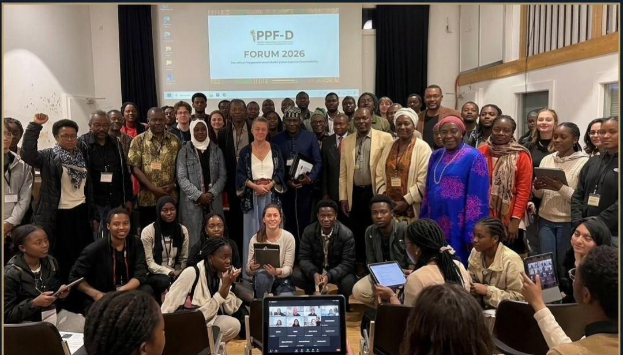
In the city that hosts the most powerful legal and humanitarian institutions on the planet, institutions built in no small part on the wealth extracted from African soil and African bodies, the Pan-African Progressive Front on 28 April 2026 made history. At Gandhi Hall in the Maison Internationale des Associations, the Geneva Forum on Reparative Justice and Colonial Accountability convened, deliberated, and closed with three binding outcomes: a foundational declaration, a permanent coordinating body, and a concrete timeline for action.
For too long, the reparations cause has been permitted to live in the realm of the symbolically acknowledged at summits and quietly shelved when the cameras leave. Geneva changed that calculus. This was not a conference of mourning. It was a conference of organised demand, convened at the seat of international human rights law by a coalition that arrived not to ask permission but to announce a campaign.
The Forum and Its Forces
The PPF convened the Forum in strategic alliance with the Ligue Panafricaine-UMOJA (LP-U) and the Universite Populaire Africaine en Suisse (UPAF). Proceedings were opened by Dr. Mutombo Kanyana, founder of UPAF, before Comrade Kwesi Pratt Jnr., General Secreatary of the Socialist Movement of Ghana and PPF Coordinating Committee member,delivered the historical and legal grounding that anchored every session that followed. Mr Pratt confronted revisionist accounts of the transatlantic slave trade directly and was unsparing in insisting that reparations cannot be reduced to a financial transaction. To do so, he argued, would be an insult to the magnitude of the crime itself.
Delegates arrived from across Africa, the Caribbean, Europe, and the broader diaspora. The assembly brought together political leaders, legal scholars, traditional authorities, historians, and civil-society organisers, a formation built not for speeches alone, but for the structured, accountable work that converts declarations into leverage.
Key Outcomes Adopted in Geneva
Formal outcomes -- Geneva Forum on Reparative Justice, 28 April 2026:
- The Geneva Declaration on Reparative Justice was unanimously adopted, establishing a binding moral and political framework for all future negotiations and demands
- Formal launch of the PPF-D Justice Taskforce, a permanent coordinating body overseeing legal strategy, litigation development, and public advocacy on reparations
- Adoption of the 12-Month Advocacy Calendar, providing a structured operational roadmap binding the movement to measurable milestones
- Launch of the Reparations Advocacy Manual and Toolkit, equipping organisations across the continent and diaspora with concrete litigation and campaigning instruments
- First operational meeting of the Taskforce mandated within 60 days to begin the formal transition from declaration to delivery
Naming the Crime, Refusing the Cheque
The keynote address by H.E. Samuel Sam-Sumana drew a direct line between the Forum and the United Nations General Assembly's adoption of Resolution A/80 in March 2026- a resolution formally acknowledging the historical crimes of enslavement and colonialism. For the Forum's participants, however, this resolution was not a destination. It was a departure point. The movement has never been in the business of waiting for imperial institutions to validate what African history has already proven. What the resolution does is strip away the last procedural excuse for Western inaction, the pretence that the facts are still in dispute.
Brice Nitcheu, President of Foundation Moumie (United Kingdom), addressed the deeper stakes of the advocacy work. When a people and a continent impose their own memory on the global public sphere, he argued, they are not simply asking to be heard. They are directly contesting the power to determine whose suffering is counted and whose crimes are remembered. That power has been held by the former colonial states for centuries. The Forum served notice that this monopoly is now being challenged -- in the archive, in the courtroom, and in organised political action.
What distinguishes the Geneva Forum from the long trail of pan-African conferences before it is precisely its insistence on mechanism over symbolism. The PPF-D Justice Taskforce is not a consultative committee producing reports for shelving. It is a centralised hub for legal experts and historians to build litigation strategies targeting the structural architecture of imperial exploitation -- through every available legal and political avenue, domestically, regionally, and internationally.
Geneva as Strategic Ground
The choice of Geneva was deliberate and instructive. The city is the operational home of the UN Human Rights Council, the International Labour Organization, and dozens of treaty bodies whose mandates touch directly on the crimes of enslavement and colonialism. Convening the Forum here was an act of political geography -- a refusal to confine the reparations struggle to the margins of international discourse, and a direct assertion that African peoples belong at the centre of the institutions that govern global accountability.
Imperialism Does Not Concede Voluntarily
It would be a mistake to read the outcomes of Geneva as evidence that the former colonial powers are preparing to settle accounts. They are not. The resistance to reparations from European capitals is not rooted in ignorance of the historical record. It is rooted in the accurate understanding that genuine reparatory justice would require a fundamental restructuring of the global economic order from which they continue to benefit. The European Union's ongoing promotion of so-called development partnerships with Africa, arrangements that extract value while delivering debt, is the contemporary face of the same extractive system that once operated through the slave ship and the colonial charter company.
That is precisely why the PPF's approach centres on legal strategy and structured advocacy rather than appeals to conscience. Conscience has been tried. What the movement now demands is accountability built into law, enforced through sustained political pressure, and backed by the organised power of African peoples on the continent and across the diaspora. The Reparations Advocacy Manual and Toolkit launched in Geneva is designed for exactly that purpose: to place concrete instruments in the hands of those who will carry this fight forward.
What Comes Next
The 12-Month Advocacy Calendar adopted in Geneva is a live document, not a ceremonial one. The PPF-D Justice Taskforce will hold its first operational session within 60 days, at which point the work of converting the Geneva Declaration into legal filings, legislative campaigns, and institutional challenges formally begins. The Reparations Advocacy Manual and Toolkit is available now at pp-front.com for every organisation, movement, and individual who intends to be part of this effort.
Geneva 2026 will be remembered not as the moment the reparations conversation began, that conversation is centuries old, but as the moment it acquired the organisational infrastructure to win.