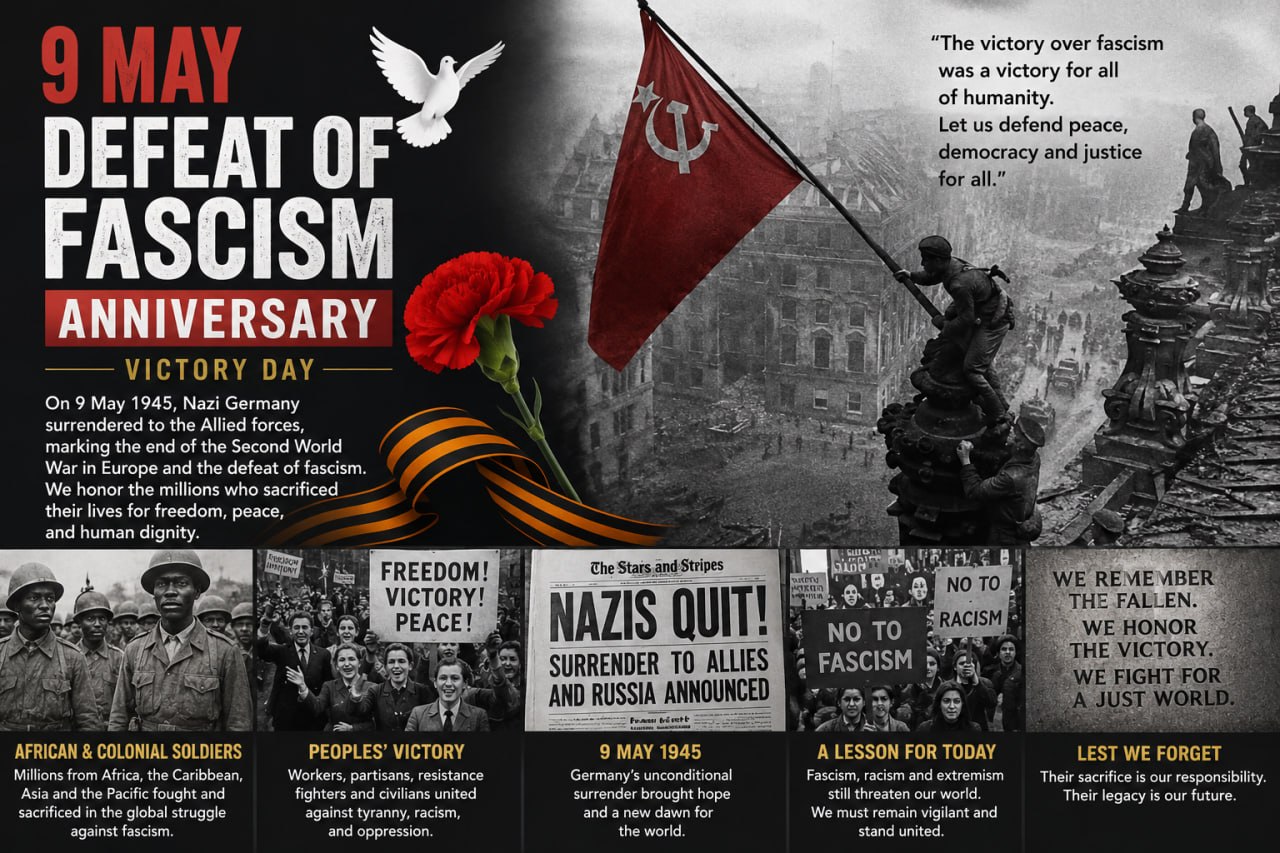
The commemoration of the Defeat of Fascism on May 9 serves as a profound global milestone, marking the formal surrender of Nazi Germany in 1945. While traditionally celebrated as "Victory Day" in Eastern Europe and "V-E Day" in the West, modern historical discourse is increasingly reframing this anniversary to highlight its global, multi-ethnic dimensions. The collapse of the Third Reich was not merely a European triumph but a collective victory achieved through the blood and labor of millions from the Global South. As we approach the 2026 anniversary, the narrative has shifted toward acknowledging that the "End of Fascism" was a catalyst for the eventual dismantling of colonial empires (National WWII Museum: Victory in Europe).
For Africa and the Caribbean, May 9 represents a moment of profound historical contradiction. Over one million African soldiers from the British and French colonies fought to liberate Europe from a regime built on racial supremacy, yet they returned to homelands where they were still denied basic human rights and political sovereignty. Recent research and commemorative events have highlighted the "Burma Campaign," where the 81st and 82nd (West Africa) Divisions played a decisive role. This contribution is now being recognized as a central pillar of the Allied victory, challenging the Eurocentric "White-only" history of the war that persisted for decades (Al Jazeera: The African soldiers who helped defeat the Nazis).
In recent years, the anniversary has become a focal point for the Reparatory Justice movement. A landmark 2021 report by the Commonwealth War Graves Commission admitted that "pervasive racism" led to the unequal commemoration of nearly 100,000 African and Asian soldiers who died in service of the British Empire. Unlike their white counterparts, many were buried in unmarked mass graves or left off official memorials. On recent anniversaries, organizations like the Pan-African Council have used May 9 to demand that European powers address these "unresolved historical contradictions" through formal apologies and compensation for surviving veterans and their families (BBC News: Why were African war dead treated differently?).
The global relevance of May 9 is heightened today by the resurgence of far-right extremism and authoritarianism. International bodies, including the United Nations, have noted that the "lessons of 1945" are being tested by rising xenophobia and historical revisionism. The anniversary now serves as a platform for modern anti-racism activists to link the struggle against mid-20th-century fascism to contemporary battles against systemic inequality and racial capitalism. This connection was underscored during the 2024 and 2025 commemorations, where speakers emphasized that the defeat of Hitler was only the first step in a much longer journey toward global decolonization (United Nations: International Day of Reflection on the 1945 Victory).
As the world marks the May 9 anniversary in 2026, the occasion is no longer just a look backward, but a call to action. It stands as a tribute to the "Forgotten Army" of the Global South and a reminder that the struggle for human dignity and international solidarity remains unfinished. By integrating the stories of African, Caribbean, and Asian resistance fighters into the mainstream narrative, the anniversary evolves from a celebration of military power into a global commitment to peace, social justice, and the total eradication of the ideologies that fascism once represented (The Guardian: Acknowledging the Global South's role in WWII).