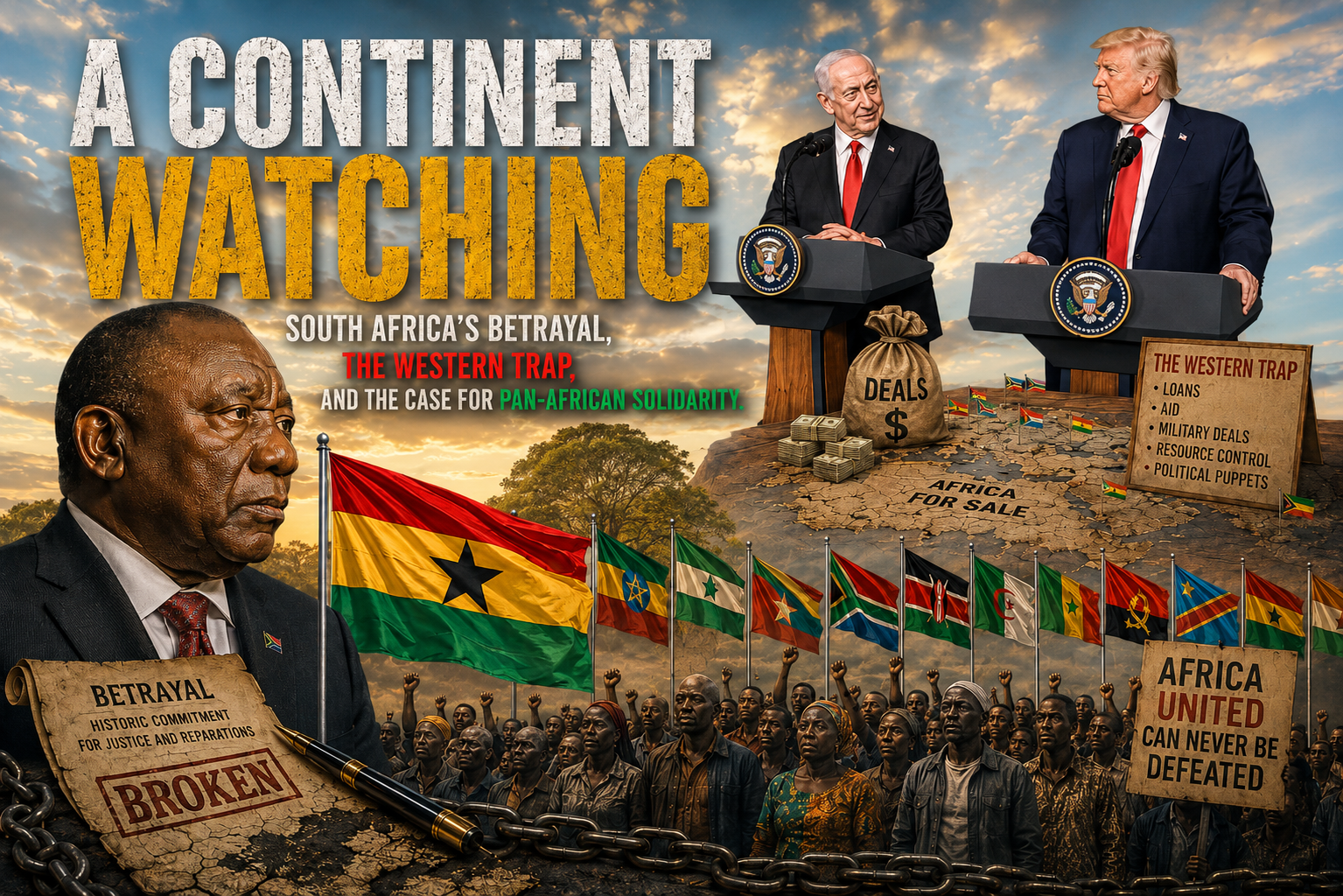
Thirty-two years after Nelson Mandela walked out of Prison and the world wept with hope, South Africa remains the most unequal country on earth. Not one of the most unequal. The most unequal. Full stop. The World Bank ranks it first among 164 nations in its Global Gini Coefficient database. White South Africans, less than 8% of the population, still own 80% of private land and hold 77% of shares on the Johannesburg Stock Exchange. Their unemployment rate is 8%. The national rate is above 32%. Close to 60% of South Africans live below the poverty line in 2025. This is not the residue of apartheid alone. This is what thirty years of deliberate policy choices look like when you add them up.
The Day the ANC Chose the Market Over Its People
In 1996, the ANC abandoned its own people-centred Reconstruction and Development Programme and replaced it with GEAR, Growth, Employment and Redistribution, a structural adjustment programme dressed in liberation clothing, designed in consultation with the World Bank and IMF, institutions that have never liberated anyone from anything. The ANC did not implement GEAR under duress. It chose it. And it paid for that choice with every year of collapsed public services, rolling blackouts, and a working class that has never, in thirty years of democracy, been given what the Freedom Charter promised.
The 2024 elections delivered the verdict. The ANC fell below 40% for the first time since 1994. Rather than reading this as a mandate to finally turn left, the party moved right, forming a Government of National Unity with the Democratic Alliance, the party of white capital, and handing it major portfolios. The privatisation of Eskom is proceeding. The South African Communist Party, straining under the weight of that betrayal, announced it will contest the 2026 local government elections independently, the first time it has stood separately from the ANC in democratic South Africa. The formal alliance technically holds, dual membership remains, but the SACP's general secretary Solly Mapaila was blunt: the ANC was arrogant, refused to reconfigure the alliance, and left the party no choice. When even your oldest ideological partner is walking away from you at the ballot box, something fundamental has broken.
Every African government negotiating with the IMF, the World Bank, or a bilateral 'development partner' from Washington or Paris is entering that same room South Africa entered in 1994. The conditions always point in one direction: open your markets, privatize your services, protect foreign investors, do not tax capital. South Africa played by those rules faithfully. The continent must look at the result and refuse to follow.
The Xenophobia Wave Nobody Wants to Trace Back to Its Source
In April and May 2026, just as South Africa's ICJ genocide case against Israel was deepening in significance, just as Brazil, Ireland, and Belgium were formally joining the case and the Global South was consolidating around South Africa's legal position, a coordinated wave of anti-African violence exploded in Johannesburg, Pretoria, and Durban. Movements called Operation Dudula and March and March, the latter described by Daily Maverick as a 'shadowy anti-foreigner movement', marched through major cities, blocking African migrants from hospitals, shutting down foreign-owned businesses, and killing people. Two Nigerian nationals died in separate incidents involving South African security personnel in April 2026.
The question is, who benefits from this? Not the South African worker, who gains nothing from a Zimbabwean shopkeeper being driven out of Soweto while the mining houses that own his labour go untouched. Not the South African state, which is now managing a continental diplomatic crisis on top of an ICJ case, an economic collapse, and a fracturing governing coalition. Not the people of Gaza, whose case loses solidarity momentum every day African governments are distracted. The only clear beneficiary is the network of interests that needs South Africa isolated, discredited, and too consumed by internal fires to prosecute a genocide case that has shaken Western impunity to its foundations.
The timing cannot be treated as coincidental. Israel and the United States had already explicitly warned South Africa it would 'pay a heavy price' for the ICJ litigation. Israeli diplomats were instructed to threaten South African counterparts in Washington. South Africa had filed over 750 pages of evidence and 4,000 pages of exhibits. And at precisely the moment when African continental solidarity around that case would be most powerful, a xenophobia crisis erupts and sets African governments against each other instead.
The mechanism is not subtle. If African nations withdraw solidarity, recall ambassadors, or channel their energy into sanctioning South Africa over migrant violence, then South Africa's diplomatic position is hollowed out without a single Western government having to punish it openly. The continent does the oppressor's work for free. African anger at African violence becomes the instrument by which the Global South's most important legal challenge to Western impunity is drained of political capital.
This does not mean every marcher is a foreign agent. The grievances being exploited are real: 32% unemployment, collapsed hospitals, a state that has never delivered. These are the precise frustrations Vigilante groups feed on. The soil for this violence has been prepared by thirty years of ANC neoliberalism. But grievances being real does not mean their targeting is organic. This is not spontaneous public anger. This is information warfare, with one target being the African continental solidarity.
How Ghana's AU Complaint Hands South Africa's Enemies Exactly What They Need
The damage is already real and widening. Nigeria's foreign minister formally called her South African counterpart after two Nigerian nationals were killed in incidents involving South African security personnel in April 2026. Ghana filed a formal diplomatic complaint to Pretoria and has since requested a debate at the African Union summit in Cairo specifically on what it calls the xenophobic attacks against African nationals in South Africa. Mozambique's president raised the matter directly with Ramaphosa. Kenya issued a travel advisory urging its citizens to avoid protest areas. The East African reports several governments are monitoring the situation amid fears for their nationals.
Ghana's request to the AU for a formal debate deserves particular attention because it is not simply a protest. It is a structural move. If the AU takes up a formal resolution condemning South Africa's treatment of African migrants, it creates a mechanism by which South Africa can be politically isolated on the continent at precisely the moment it needs African solidarity most. A South Africa debated and potentially censured at the AU over xenophobia cannot lead the African bloc at the ICJ with the same authority. The moral standing that gave South Africa the credibility to file the genocide case, rooted in its own history of racial oppression and liberation, is the same moral standing that is being systematically targeted. Strip that, and you strip the case of its most powerful framing.
A South Africa fighting diplomatic fires in Abuja, Accra, and Maputo is a South Africa distracted from The Hague. An AU debating whether to sanction South Africa over xenophobia is an AU not debating Western imperialism, not standing behind the ICJ case. The agenda has been changed. The room has been redirected. This is the oldest colonial playbook there is: get Africans fighting each other and you never have to fight them yourself.
None of this absolves the ANC. Its silence as Operation Dudula grew was a political choice. A state too captured by market interests to protect its own poor will not protect migrant poor either. African governments furious about the treatment of their nationals must demand accountability. But they must also ask, loudly: who is handing these movements a megaphone, who is amplifying this crisis in international media, and why is it exploding at precisely the moment when African unity around South Africa would be most dangerous to those with the most to lose from the ICJ proceeding? The African Commission on Human and Peoples' Rights has called for these vigilante groups to be dismantled. Correct. But every African government must also have the courage to ask the second question: who built them?
Pan-Africanism from the Left Is Not a Slogan. It Is the Only Way Out.
South Africa, Palestine, Afrophobia and the xenophobia crisis are not separate stories. They are one story about what happens to a country and a continent that fails to control its own economic destiny, that can be punished for exercising sovereign foreign policy, and that can be turned against itself when it becomes inconvenient to power.
Pan-Africanism from the left is the only framework adequate to this moment. Not Pan-Africanism as sentiment or slogan, but as a political programme, one that insists on land redistribution within nations, not just sovereignty between them; on workers having a stake in their economies; on intra-African trade that stops the continent exporting raw materials to be processed elsewhere and reimported at ten times the price; on a monetary architecture free from the CFA franc, the dollar, and instruments of Western control dressed as financial integration. Frantz Fanon, whose centenary falls this year, warned that national liberation without social liberation is just a transfer of the colonial apparatus from white hands to Black hands, with the same people on the bottom. South Africa is the most expensive proof of that warning on earth.
The generation rising across this continent is not asking for reforms. It is asking who owns the land, who controls the resources, why the water runs out before it reaches their neighbourhood. South Africa's tragedy is that its government stopped asking those questions thirty years ago. The continent's task, urgent and non-negotiable, is to make sure no other government gets away with that silence again.