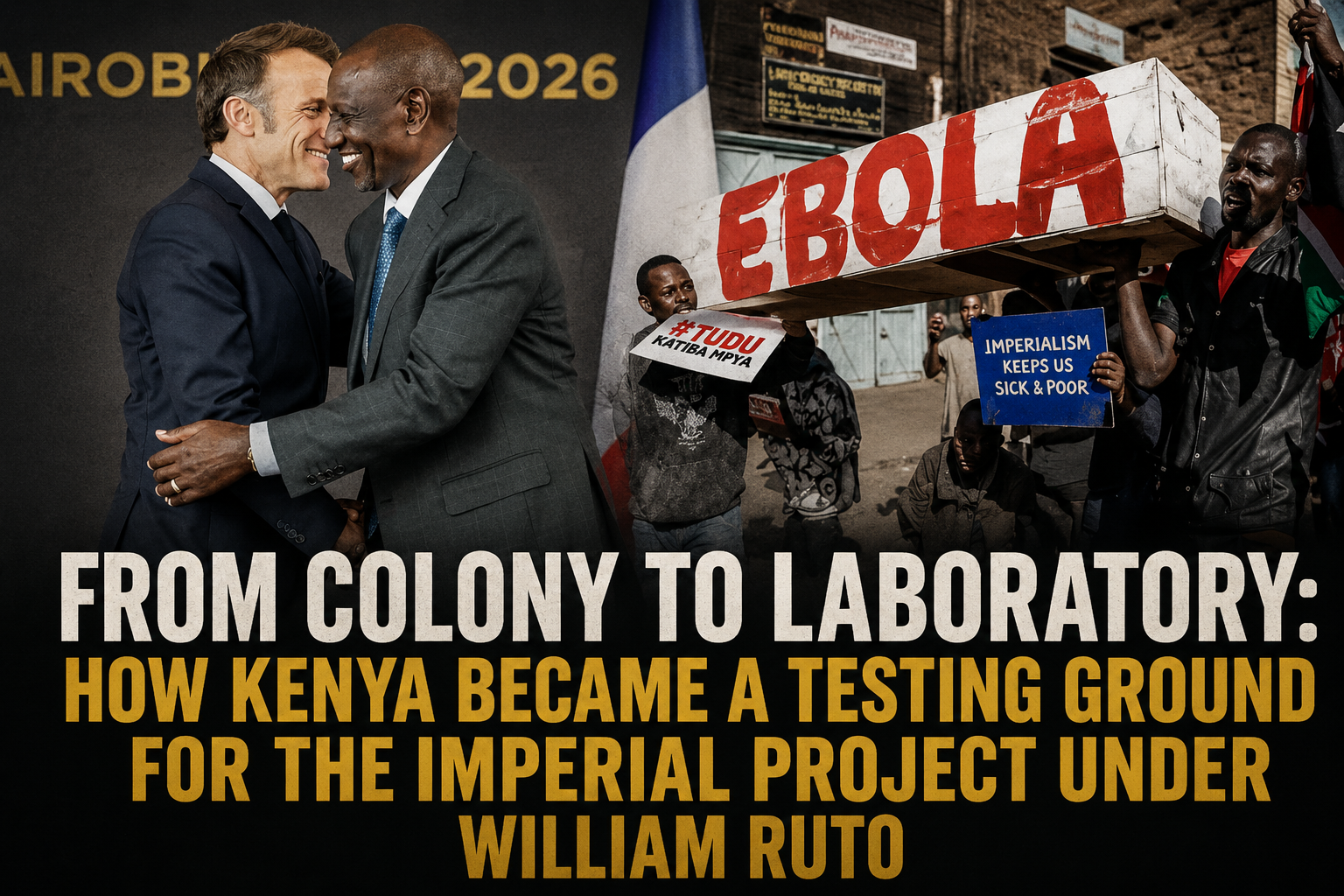
In the space of barely four years, Ruto has transformed Kenya into the anchor of a Western imperial reboot on the African continent. He has handed France a strategic lifeline after the humiliation of the Sahel expulsions. He has handed the United States a biohazard dumping ground on Kenyan soil. He has stationed British, American, and now French troops on Kenyan territory while his security forces shoot unarmed protesters in the streets. And through every transaction, every handshake on the steps of State House, every appearance at the G7 and the Africa Forward Summit, Ruto has not merely accommodated imperial interests. He has marketed them, packaged them, and sold them to the continent as African leadership.
There is a particular kind of African leader that imperialism prizes above all others. Not the puppet who must be manipulated and coerced. Not the ally who must be bribed and threatened into compliance. The prize is the self-turning key: the leader who, without prompting, without coercion, without even the pretence of reluctance, opens the doors of sovereignty and waves the imperial powers in. Ruto is that key. He is also the hand that turns himself. To understand how Kenya arrived at this moment, we must travel further back than Ruto's 2022 election. The coordinates of today's crisis were set in 1963, when the Union Jack came down, but the architecture of extraction stayed standing. What we are witnessing now is not a new colonisation. It is the latest iteration of a very old one, administered this time by a Kenyan hand.
How France Came to Nairobi After Being Driven Out of the Sahel at Gunpoint
To understand why France is in Nairobi in 2026, you must understand why France is no longer in Bamako, Ouagadougou, Niamey, N'Djamena, or Dakar. Between 2022 and 2025, popular movements across the Sahel, organised under explicitly pan-Africanist and anti-imperialist slogans, forced the expulsion of French forces from five countries in fewer than thirty months. These were not military coups alone. They were political processes animated by mass anger at what the people of the Sahel correctly identified as decades of Françafrique: the system of French domination that had strangled Sahelian sovereignty since the formal end of colonial rule. Mali, Burkina Faso, and Niger formed the Alliance of Sahel States and later withdrew from the Organisation Internationale de la Francophonie. Billions of euros in French strategic positioning, military infrastructure, and political influence evaporated at a speed that shocked Paris.
Emmanuel Macron's response was not to reckon with the history that produced this rejection. It was to find a replacement market. That market is Kenya. Macron had agreed the Africa Forward Summit with Ruto on the sidelines of the UN General Assembly in September 2024. On 11 and 12 May 2026, Nairobi hosted the gathering, the first France-Africa summit ever held outside a Francophone country. Over thirty heads of state and government attended. France announced 23 billion euros in investment commitments across energy, agriculture, and digital sectors. Macron stood at the KICC and described the relationship as a 'partnership of equals' aimed at resetting France's ties with the continent.
The language of reset and partnership deserves to be assessed against its function. France had been expelled from the Sahel by movements operating under pan-Africanist slogans. Its answer was to relocate to East Africa, to stage a pan-African summit in Nairobi, to stand beside a Black African head of state and declare France the true partner of the continent. The political content of the summit was, in this sense, a direct counter-move against the ideological ground on which France had been defeated. It was not a genuine rethinking of the extractive relationship. It was a rebrand, and Ruto provided the venue, the credibility, and the intellectual cover.
Macron subsequently invited Ruto to the G7 summit while pointedly excluding South Africa's Cyril Ramaphosa. South Africa's sin, from the perspective of Western imperial priorities, is the ICJ genocide case against Israel, a case of historic significance for which South Africa has drawn the explicit hostility of Washington and its allies. The message to the continent required no translation: compliance with Western strategic interests earns access and prestige; principled legal action for African and Palestinian solidarity earns exclusion. Ruto has read this calculus clearly and positioned himself accordingly. He has condemned Iranian strikes on Gulf states, deployed Kenyan troops to the US-managed Haiti intervention, and hosted the France-Africa summit. Each transaction purchases him another invitation.
When Washington Decided African Soil Was the Right Place to Dump Its Ebola Problem
If the Africa Forward Summit represents the diplomatic architecture of Kenya's subordination, the Ebola quarantine facility at Laikipia Air Base represents its biological dimension. And both, examined together, reveal the same underlying logic: Kenyan territory as buffer, as absorber of risks that Western states generate and refuse to carry.
In late May 2026, with an active Ebola outbreak centred in the Democratic Republic of Congo's conflict-plagued Ituri Province and spreading toward Uganda, the Trump administration announced that no American citizen who contracted Ebola abroad would be permitted to return to the United States for treatment. Secretary of State Marco Rubio was precise: 'We cannot and will not allow any cases of Ebola to enter the United States.' Instead, a 50-bed isolation and biocontainment facility was to be established at Laikipia Air Base in Nanyuki, central Kenya. Thirty US Public Health Service officers had already completed three weeks of training and departed for the site. Trump administration officials described the facility as 'state-of-the-art' and insisted it was 'designed to provide access to high-quality care for Americans who would need to quickly get out of DRC and quarantine without the risks of a lengthy evacuation.'
The geography of this arrangement is its most revealing feature. Kenya has never recorded a single confirmed Ebola case. The nearest active outbreak zone is more than 1,500 kilometres away. The facility was not constructed to address any Kenyan public health emergency. It was constructed because the United States government decided that its citizens infected with a lethal pathogen should be placed on African soil rather than American soil. The Katiba Institute, Kenya's constitutional watchdog organisation, named this arrangement with precision in its legal challenge: Kenya had been selected as an alternative containment site, externalising infectious disease risk management to Kenyan territory. This is not hyperbole. It is an accurate description of what was agreed.
Rubio telephoned Ruto and, as a fee for Kenya's compliance, offered 13.5 million dollars toward Kenya's Ebola defence operations. Kenya's annual health budget is approximately 1.3 billion dollars. This means the United States paid Kenya roughly 1% of its annual health expenditure to absorb American biosecurity risk. Ruto told reporters he gave the OK because 'friends who have worked with Kenya for thirty to forty years' had asked him to, and urged the Kenyan people to 'relax.' He described it as 'the right thing.'
Kenya's courts and civil society did not relax. The Katiba Institute filed a constitutional challenge citing lack of transparency, the absence of public participation, and what it described as constitutional recklessness with grave public health implications. High Court Judge Patricia Nyaundi issued conservatory orders on 28 May 2026 barring the establishment or operation of any Ebola-related facility under agreements with foreign governments and banning the admission of any person exposed to or infected with the virus. The orders were extended on 3 June 2026. In response to these binding court orders, the Kenyan government and the United States government continued construction. A Katiba Institute legal team that attempted to verify compliance was blocked at the base gate by the Kenya Defence Forces. Satellite imagery obtained by Reuters and confirmed by CNN showed tents erected and vehicles active at the site days after the court orders were issued. The Katiba Institute announced it was preparing contempt of court proceedings against both governments.
On 1 and 2 June 2026, hundreds of protesters took to the streets in Nanyuki, the town nearest the base. Two people were shot dead. Police fired teargas and detained demonstrators. By 9 June 2026, protests had spread to Nairobi, where activists carried mock coffins and placards through the streets as police deployed water cannons and live rounds. Ruto's government did not halt construction. It dismissed the protests, dismissed the court orders, and continued. Former Deputy President Rigathi Gachagua, now an opposition figure, claimed that military personnel at the base had contacted him privately, expressing fear of Ebola exposure to their own families living in the barracks and asking him to protest on their behalf, since they had no voice. Even the soldiers guarding the facility were afraid. Only Ruto was not.
The People Are in the Streets Again and the Security Forces Are Still Shooting
The Kenyan people have not relaxed. Since Ruto took office, they have not stopped bleeding either. During the June 2024 Gen Z protests against his IMF-driven Finance Bill, police killed more than 60. On Saba Saba Day in July 2025, at least 38 were killed and 130 injured in a single day. Interior CS Kipchumba Murkomen described the protests as a coup attempt and told officers to shoot on sight. Ruto told them to shoot protesters in the leg. A BBC forensic analysis of over 5,000 images later confirmed that those killed by security forces posed no threat when fired upon. Youth unemployment stands at 67%. Formal sector job creation collapsed from 123,000 new positions in 2023 to 75,500 in 2024 under IMF austerity. Now, in June 2026, protesters are carrying mock coffins through Nairobi again. The same governments arming and training Kenya's security forces sat beside Ruto at the Africa Forward Summit and called him a partner in stability.
Fanon Told Us This Would Happen. The Sahel Told Us What Comes Next.
Frantz Fanon was precise about the political formation that produces a William Ruto. Writing in The Wretched of the Earth six decades ago, he described what happens when a post-colonial national middle class achieves state power without a genuine programme of decolonisation. It does not transform the colonial economic structure. It steps into the position vacated by the coloniser and performs the same extractive function with a different face. The mines remain, but the manager is now African. The debt instruments remain, but the signatory is now African. The troops remain, but the handshake welcoming them is now African. The comprador does not need to be bribed or coerced into this arrangement. He has been formed by it, educated for it, and rewarded by it. He is not a collaborator who sold out. He is a product of a system that produces such collaborations as its normal output.
Ruto is not a policy failure. He is a structural success from the perspective of imperialism: a self-activating comprador who requires no coercion, demands no pretence of reluctance, and markets his own subordination as continental vision. He speaks the language of finance capital and calls it pan-Africanism. He signs immunity agreements for foreign soldiers and calls it partnership. He accepts an Ebola quarantine facility built over court orders and calls it solidarity with friends. He tells the people who are being shot to relax. He is, in the precise Fanonian sense, the national bourgeoisie's most complete expression: a man who has fully internalised the logic of empire and reproduced it as his own programme.
And yet the Sahel has proven that this is not permanent. France was not expelled from Mali, Burkina Faso, Niger, and Chad by accident or by diplomatic negotiation. It was expelled by the organised will of populations who had been told for decades that French military presence was the price of stability, who looked at the evidence and concluded that the presence was the instability. The Alliance of Sahel States did not emerge fully formed from the heads of its leaders. It was built, organically and under fire, by movements that refused to accept the terms of their subordination. They paid a price. The sanctions continue. The Western media hostility continues. But the troops are gone.
The Kenyan people are already in that fight. They have been in it since 2024. They stormed Parliament and forced the withdrawal of a Finance Bill that the IMF required. They returned to the streets on the anniversary of those killings and were shot again. They filled Nanyuki with their bodies to protest an Ebola facility being built in defiance of their courts. They are carrying mock coffins through Nairobi while their president attends summits with the leaders of the governments whose policies produced the coffins. The 64% of Kenyans who told pollsters in 2025 that they were more afraid to protest than they had been in 2024 protested anyway. They are throwing the teargas back.
The pan-Africanist left has a responsibility in this moment that is not academic. The Ruto government represents the full flowering of the comprador model, in the same geographic territory where BATUK has operated for six decades, in the same Laikipia that now houses both the British training ground and the American Ebola facility, in the same Nairobi that just hosted France's attempted rehabilitation as a pan-African power. Kenya is not becoming a laboratory. It has been one since 1964. What is new is the acceleration, the multiplication of imperial presences, and the brazenness with which a government elected by Kenyans administrates the arrangement on behalf of powers whose interests are structurally hostile to Kenyan sovereignty, Kenyan health, and Kenyan life.
The answer is not a better manager of dependency. It is the end of the dependency architecture itself: the dismantling of the IMF frameworks that generate austerity, the renegotiation or abrogation of defence agreements that grant foreign soldiers immunity from Kenyan law, the prosecution of those responsible for the deaths of 130 protesters, and the construction of a foreign policy grounded in genuine pan-African solidarity rather than access to Western summits. The Sahel proved it is possible. The streets of Nairobi, Nanyuki, Kisumu, and Kisii are proving that the demand for it is alive. History will record whether the movement that carries it forward was equal to the moment. It will also record, with no ambiguity, what Ruto chose to do with the keys.