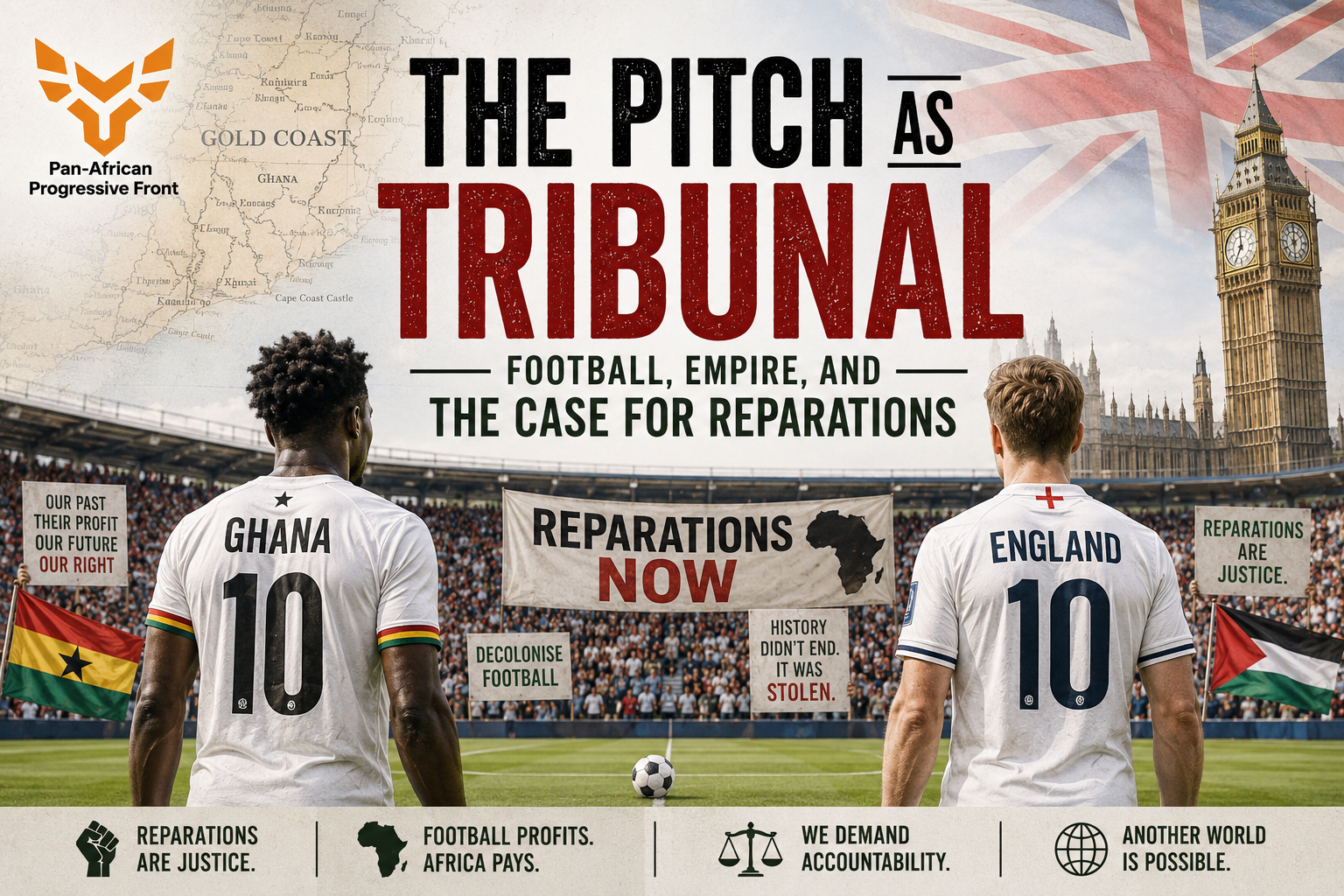
When Ghana plays England at the 2026 FIFA World Cup, it will not simply be a football match. It will be, whether FIFA intends it or not, a confrontation between a coloniser and the colonised, between a metropole that extracted centuries of labour, gold, and human beings from the Gold Coast, and the nation that rose from that wreckage. The scoreline will carry weight that no commentator is likely to acknowledge. But the peoples of the Global South know what is at stake every time a former colony lines up against its former master.
These encounters are not rare. They are structural. The architecture of world football, shaped by the same European powers that carved up Africa in Berlin in 1884, regularly produces these meetings. Senegal against France. Algeria against France. Morocco against Spain. Each group stage draw, each knockout bracket, risks reproducing on the pitch the asymmetries of the colonial world order. And yet these matches also produce some of the most charged moments in sporting history, not despite that history, but because of it.
The 2026 World Cup, with its expanded 48-team format hosted across the United States, Canada, and Mexico, has delivered more of these fixtures than any tournament in history. Nine African nations are on the pitch. Former colonies face former masters across six different groups. The draw was conducted in Washington DC, at the Kennedy Center, in the most lavishly funded imperial capital on earth. What the television cameras did not explain, what the smiling presenters did not mention, is that the ballot had quietly arranged a set of appointments that carry the weight of centuries.
Group L: England vs Ghana- The Gold Coast Settles Nothing, and Everything
England extracted gold, timber, and eventually human beings from what it called the Gold Coast for nearly two centuries. The name was not poetic. It was a business description. By the time Ghana declared independence in 1957 under Kwame Nkrumah, Britain had taken what it needed and left behind a country whose economic infrastructure was designed to serve London rather than Accra. Nkrumah called it neo-colonialism. The World Bank called it a development problem. The terminology reflects whose interests were being protected.
Ghana's greatest World Cup wound did not come against England but is inseparable from this history. In 2010, with South Africa hosting what was supposed to be Africa's first World Cup, Luis Suarez's deliberate handball denied Ghana a goal that would have put them in the semi-finals. The penalty was missed. The continent's hopes ended by a single act.
The Three Lions arrive with superior resources, superior wages, and an infrastructure built over centuries of extraction. Britain removed an estimated 45 trillion dollars from India alone. The figures for Africa, accounting for the slave trade, colonial extraction, and the ongoing capital flight through illicit financial flows, are staggering and incompletely tallied. The scoreboard will show goals. The ledger shows something else entirely.
Group I: France vs Senegal — Whose Team Is It, Actually?
This is the fixture the reparations movement should be loudest about. France and Senegal in the same group is not simply a football match between two nations. It is a meeting between an empire and one of its most plundered territories, played out by a French squad whose composition tells a story that French politicians have spent decades refusing to honestly confront.
Look at the French national team. Kylian Mbappe, born in Bondy to a Cameroonian father and an Algerian mother. Marcus Thuram, son of Guadeloupe-born Lilian Thuram. Ousmane Dembele, with Senegalese and Malian roots. Eduardo Camavinga, born in a refugee camp in Angola. Randal Kolo Muani, with Congolese heritage. The majority of France's most gifted footballers are the children and grandchildren of people who came from the nations France colonised, occupied, enslaved, and extracted. Commentators have called it an African team in a French shirt. They usually mean it as an observation. It is actually an indictment.
France's colonial record is not an abstraction. It is the direct ancestor of the demographics in the current squad. France colonised Algeria from 1830 and refused to leave for 132 years. The war of independence cost between 500,000 and 1.5 million Algerian lives. France colonised Senegal and made it the administrative capital of French West Africa, a bureaucratic structure designed not to develop Senegal but to extract from the entire region more efficiently. France imposed the policy of assimilation, the doctrine that colonial subjects could become fully French if they abandoned their language, their religion, their culture, and their sense of collective identity. It was a civilisational demand dressed as an offer. Those who refused were subjects. Those who accepted were never quite citizens.
The descendants of those subjects now wear the blue shirt. They score the goals. They win the tournaments. And when they celebrate, in certain political circles in France, their Frenchness is suddenly qualified again. Mbappe has been told to stay out of politics. French players who expressed support for Palestine have faced pressure. The assimilation policy did not end. It evolved. It now says: you may represent France on the pitch, but you may not speak about what France did to the countries your families came from.
The CFA franc is the clearest proof that French colonialism did not end in 1960. Fourteen African nations, including Senegal, use a currency pegged to the euro, managed by the French treasury, with member states required to deposit a significant portion of their foreign exchange reserves in Paris. This arrangement, inherited directly from the colonial period, has survived into the twenty-first century. The AES states, Mali, Burkina Faso, and Niger, have recently moved to exit this arrangement and France has resisted the rupture with everything short of open military force. Senegal's own debate about monetary sovereignty is live and intensifying.
When Senegal beat France 1-0 in 2002, Papa Bouba Diop scored and Dakar erupted in a way that no league match could have produced. The celebrations were not simply about football. They were the sound of a people expressing something institutional settings rarely permit: that the relationship between France and its former colonies is neither natural nor just, and does not have to be permanent. In 2026, the fixture is back. The CFA franc is still in place. The match will not decide monetary policy. But it will be watched by every person in the Franc Zone who knows exactly what is at stake beyond the ninety minutes.
The French Team Is the Reparations Argument Made Flesh
Return, once more, to France. The France squad at the 2026 World Cup is not only the most politically charged team in the tournament for what it will do on the pitch. It is politically charged for what it represents before a ball is kicked.
The players who will carry France to potential glory are overwhelmingly the children of the empire. Their parents and grandparents came from Algeria, Senegal, Cameroon, Mali, Congo, Guadeloupe, Martinique, and other territories that France governed, extracted, and in many cases continues to hold in various forms of economic dependency. They came to France because France was in their countries first. They or their families navigated the banlieues, the housing projects on the edges of French cities that concentrate poverty and Black and Brown populations with a precision that would be called structural racism in any honest analysis.
France's assimilation policy was always ideological cover for cultural erasure. It said to colonial subjects: your language is inferior, your religion is a problem, your customs are an obstacle, your history begins when you encounter ours. Become French and you will be accepted. The descendants of those subjects have become French. They have become the best footballers on earth. And France celebrates them as long as they win and falls back on qualification of their Frenchness the moment they speak about the world they actually come from.
When France plays Senegal, the question this piece asks is simple: whose team is it? The players in blue were shaped by a French state that was shaped by its colonies. The wealth of those colonies, the labour of enslaved and colonised people, built the infrastructure, the institutions, and the prosperity that made France a country people wanted to migrate to. The footballers are the return on an investment that was never made voluntarily and has never been repaid. France vs Senegal is not France against Africa. It is Africa, in a French shirt, facing Africa in a Senegalese shirt, with the empire standing on the sideline taking the prize money.
Group K: Portugal vs DR Congo — The Minerals Are Still Leaving
Portugal decolonised Angola, Mozambique, and Guinea-Bissau only in 1975, forced out not by imperial conscience but by a revolution inside Portugal itself. It was the last European power to leave Africa, and it left because its own working class, exhausted by a colonial war it had not chosen, overthrew the Estado Novo dictatorship that was fighting it. Portugal did not give Africa its freedom. Africa's liberation movements took it, at enormous cost.
The shadow over this fixture, however, belongs to Belgium. The Democratic Republic of Congo was King Leopold II's personal fiefdom, then Belgium's. The Congo Free State ran one of the most violent colonial regimes in recorded history. Rubber quotas enforced by mutilation. Hands severed as proof of bullets spent. Population estimates suggest the country lost half its people during Leopold's rule. What Belgium did in the Congo is not a footnote in colonial history. It is among its defining atrocities.
The DR Congo today sits atop the minerals that power the global electronics industry. The coltan in every smartphone. The cobalt in every electric vehicle battery hailed as the green future. The Congo supplies the world. The world supplies the Congo with conflict, predatory debt, and extractive multinational corporations operating under licensing arrangements that bear a strong family resemblance to colonial concession agreements. The DR Congo at the World Cup for the first time in decades is a nation of 100 million people, the second largest in Africa by land mass, back on football's biggest stage. Cristiano Ronaldo may or may not still be playing. The mineral extraction will certainly be continuing.
Group J: Algeria vs Argentina — France Is Absent, Its History Is Not
Algeria was colonised by France from 1830. The war of independence lasted eight years and cost between 500,000 and 1.5 million Algerian lives. France has never formally apologised. The Algerian diaspora in France is subjected to structural racism that is well-documented and poorly addressed. The wound has not closed. It has been administered.
France is in Group I with Senegal. Algeria will not meet its coloniser in the group stage. But history travels with the Fennec Foxes regardless. Every Algeria shirt in the stands carries the colours of a nation that the French Republic once declared was not a foreign country but an integral part of France, a juridical fiction that made the demand for independence seem like secession and made the war of liberation seem like a civil conflict. Algeria taught the world that national liberation from a coloniser who has declared you part of itself is possible. That lesson sits in every chant, in every flag.
Argentina brings its own colonial wound. A nation built on the near-total erasure of its indigenous populations, with the survivors confined to reserves and their histories written out of the national narrative. The Mapuche, the Qom, the Wichi continue to organise for land rights and recognition against a state that has repeatedly responded with repression. This match places two nations whose present conditions are shaped by different but structurally related histories of dispossession on the same pitch, watched by millions who share versions of that inheritance.
Group C: Brazil vs Haiti — The Revolution and the Slave Market
Brazil versus Haiti is the fixture that carries the heaviest symbolic freight of the entire tournament. Brazil processed more enslaved Africans than any other country in the history of the Atlantic slave trade, nearly five million people. The legacies of that system are written into Brazil's racial geography, its income distribution, its prison population, and the life expectancy gap between Black and white Brazilians that persists into the present.
Haiti is the only nation in history founded by a successful slave revolution. The Haitian Revolution of 1791 to 1804 defeated the armies of France, Spain, and Britain and produced the first Black republic on earth. France subsequently forced Haiti to pay reparations, not to the formerly enslaved but to French slaveholders. That debt took until 1947 to repay and economists have calculated it impoverished Haiti by hundreds of billions of dollars, a transfer of wealth from a country that had won its freedom to the empire that refused to accept it.
Haiti qualified for this World Cup against enormous material odds. When they face Brazil, it is not a mismatch. It is a meeting between the largest slave society in the Americas and the nation that proved the enslaved could take their freedom. No commentator will frame it that way. The history does not require their permission.
Group H: Spain vs Cape Verde — Small Islands, Long Reckonings
Spain's colonial record in Africa includes the Western Sahara, abandoned in 1976 in a process that left the Sahrawi people without a state, without a referendum, and without resolution fifty years later. Spain also colonised Equatorial Guinea, the only Spanish-speaking country in sub-Saharan Africa.
Cape Verde is a former Portuguese colony, a volcanic archipelago off the west coast of Africa with a population of around 600,000, independent since 1975. Cape Verde's qualification for 2026 is remarkable on every metric. A small island nation that has produced a generation of footballers through the European club system, who have returned to represent the Blue Sharks with fierce national pride. When they face Spain in Group H, the disparity in resources, population, and historical privilege is total. The Blue Sharks' presence on that pitch is itself an act of defiance against every assumption about who belongs at a World Cup.
The Pitch as Reparations Terrain
The economic structure of global football mirrors the economic structure of imperialism. African players generate billions in transfer fees, shirt sales, and broadcast revenue for clubs in England, France, Spain, and Germany. FIFA's distribution of World Cup revenue allocates the largest shares to UEFA confederations. When African football associations have pushed for greater revenue shares, more World Cup places, or the right to host the tournament on their own continent, they have met the same institutional resistance that African states face at the IMF and the World Bank.
The reparations movement's task at the 2026 World Cup is to make the connection between these structures unavoidable. Not by disrupting football, but by using football's extraordinary visibility to force the question of historical accountability into spaces where power has to respond. The World Cup is the most watched event on the planet. Billions of people who will never attend a reparations conference, never read a Walter Rodney text, never sit through a lecture on structural adjustment, will watch Ghana and England matches. They will watch France and Senegal. They will watch Portugal and DR Congo. The audience is already assembled.
Movements have understood this logic before. The boycott of apartheid South Africa from international sport was not incidental to the liberation struggle. It was central to it. The Palestinian solidarity movement has since demonstrated that FIFA is not immune to political campaigns, that sporting bodies respond to sustained organised pressure even when they prefer not to. These are not diversions from serious politics. They are serious politics conducted by other means.
When Ghana plays England, pan-Africanist organisations across the diaspora should be visible: outside stadiums, on social media, in every space where meaning about the fixture is being made. When France plays Senegal, the CFA franc should be in the conversation. When Portugal plays DR Congo, the cobalt and the coltan should be named. The demand is not symbolic. It is material. The debt is real. The mechanisms for its repayment are political, legal, and economic, not decided on a football pitch. But the pitch is where hundreds of millions of people are paying attention, and that attention is the terrain on which the argument for reparations must be made.
Football will not win reparations. Parliamentary delegations, legal claims before international courts, mass organising, and sustained state-level pressure are the mechanisms through which material transfers are compelled. But the reparations struggle requires a war of position alongside its war of movement. It requires contesting the ideological ground on which imperial powers have constructed their impunity: the idea that history is over, that colonialism was regrettable but finished, that the inequalities of the present are the product of culture or governance rather than centuries of organised theft.
Every time Ghana runs out against England and refuses to be merely symbolic, every time an African team reaches a stage the European press said it could not, every time the camera finds a face in the crowd that knows exactly what this game is about, the story of inevitable European supremacy takes another blow. The tribunal is in session. The ball is at our feet.