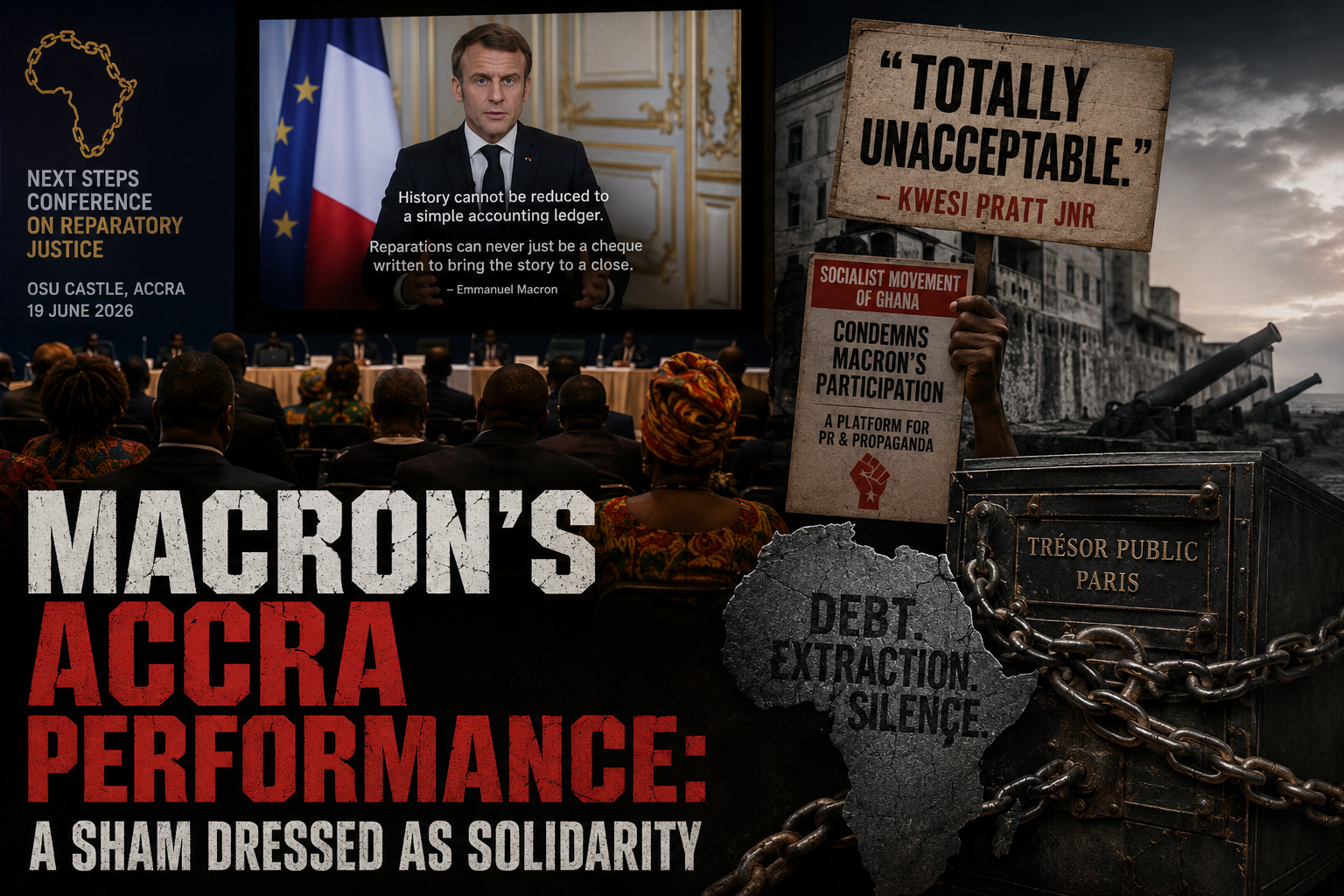
On 19th June 2026, as Africa's most consequential reparations summit in living memory closed at Osu Castle, French President Emmanuel Macron appeared on screen, not in the room. He did not fly to Accra. He addressed the Next Steps Conference on Reparatory Justice by video link from the Élysée Palace in Paris, a fact that on its own tells us everything about how seriously his government takes this question. You do not send a video message to a crime scene you claim to be sorry about.
What he said, once he appeared, deserves close attention, because it is a masterclass in saying something that sounds profound while committing to nothing at all. Macron told the conference that history cannot be reduced to a simple accounting ledger. He went further, insisting that reparations can never just be a cheque written to bring the story to a close. Listen to what that sentence actually does. It is not a rejection of one form of reparations in favour of another. It is a pre-emptive rejection of the thing Africa is actually asking for. Before anyone in Accra had finished outlining the financial architecture this movement has spent years building, the French president had already ruled out the cheque.
In its place, he offered what he called engagement with historical and scientific truth, education, research, and the return of stolen artworks. He explained that repairing is also being able to redeploy situations, the way France is doing with Haiti. Redeploy. Not repay. Not cancel a debt that costs Haiti more than a century of its national income. Redeploy, a word chosen by people whose job is to make extraction sound like partnership.
This is not new behaviour from Macron. It is a pattern. Back in 2026 in Paris, marking 25 years since France recognised slavery as a crime against humanity, he had already laid the groundwork for what would happen in Accra. He warned that on reparations, the question must not be approached with false promises, insisting France must have the honesty to say it can never fully repair this crime because it is impossible. Notice the sequencing. Months before facing African and Caribbean delegations directly, Macron had already pre-announced the limits of his own contrition, on his own soil, to his own domestic audience. By the time he appeared on a screen in Accra, the impossibility of repair was already established French government policy, not a conclusion drawn from listening to anyone in that room.
This is the oldest trick of the coloniser's grammar: arrive already finished negotiating, in a conversation you were never present for.
And he has done this before, with art. Years earlier, in Burkina Faso and Ghana, Macron built his entire reputation on a single gesture, the pledge to return African artefacts looted under colonial rule. It earned him praise around the world. It also let him sidestep the larger reckoning entirely. Around that same period, when a Frenchwoman of Congolese origin asked him directly whether France would ever pay financial reparations for colonialism, Macron called the idea totally ridiculous, adding that as a matter of mentality, it was not a way to build a future. A few stolen statues, returned with great ceremony, in exchange for permanently closing the door on the actual debt. That is the trade he has always been offering. Accra was simply its largest stage yet.
The summit itself did not pretend otherwise. More than 80 nations present called for a formal apology, financial mechanisms, debt relief, and institutional reform. Macron's contribution was a video, a lecture on memory, and a reminder that the cheque was never coming. The contrast was not lost on the delegates in the room, nor was it lost on us. Speaking on the second day of the conference, veteran journalist and PPF coordinating committee member comrade Kwesi Pratt Jnr called Macron's presence at the summit totally unacceptable, and warned against turning the forum into a platform for hollow expressions of sympathy from the very countries responsible for the crime. He was right then, and Macron's actual remarks proved him right within forty-eight hours. The Socialist Movement of Ghana went further still, issuing a statement of condemnation before Macron had even spoken, warning that handing him a platform would turn an African-led project into a European-managed one and hand France a public relations vehicle to launder centuries of looting and political interference. Reading Macron's video remarks now, after the fact, it is hard to find a single sentence that disproves them.
Consider, too, what France abstained from only months earlier. On 25th March 2026, when 123 countries voted at the UN General Assembly to declare the transatlantic slave trade the gravest crime against humanity, France did not vote yes. It abstained, citing a reluctance to create a hierarchy among crimes against humanity, an argument that sounds principled until you notice it has never once stopped France from ranking its own national interests well above anyone else's history. A government that could not bring itself to vote for that resolution does not get to arrive three months later as a moral participant in implementing it. It arrives as a government managing reputational risk, and dressing the management in the language of dialogue.
And while Macron spoke of education and memory from a palace in Paris, the CFA franc continued doing what it has done for decades, binding 14 African nations to deposit half their reserves in the French Treasury, fixing their monetary destiny to decisions made in a building Macron occupies. No video address mentioned that. No 19-point framework will dismantle it by France's own hand. The silence on the CFA franc is the loudest part of the entire speech, because it is the one form of reparation that costs Paris something real, and it is the one form of reparation that never gets mentioned.
A keynote that costs nothing, delivered from a screen, by a government that abstained on the very resolution it now claims to honour, is not solidarity. It is theatre, and Africa has seen this play before. The difference this time is that we are no longer required to applaud.