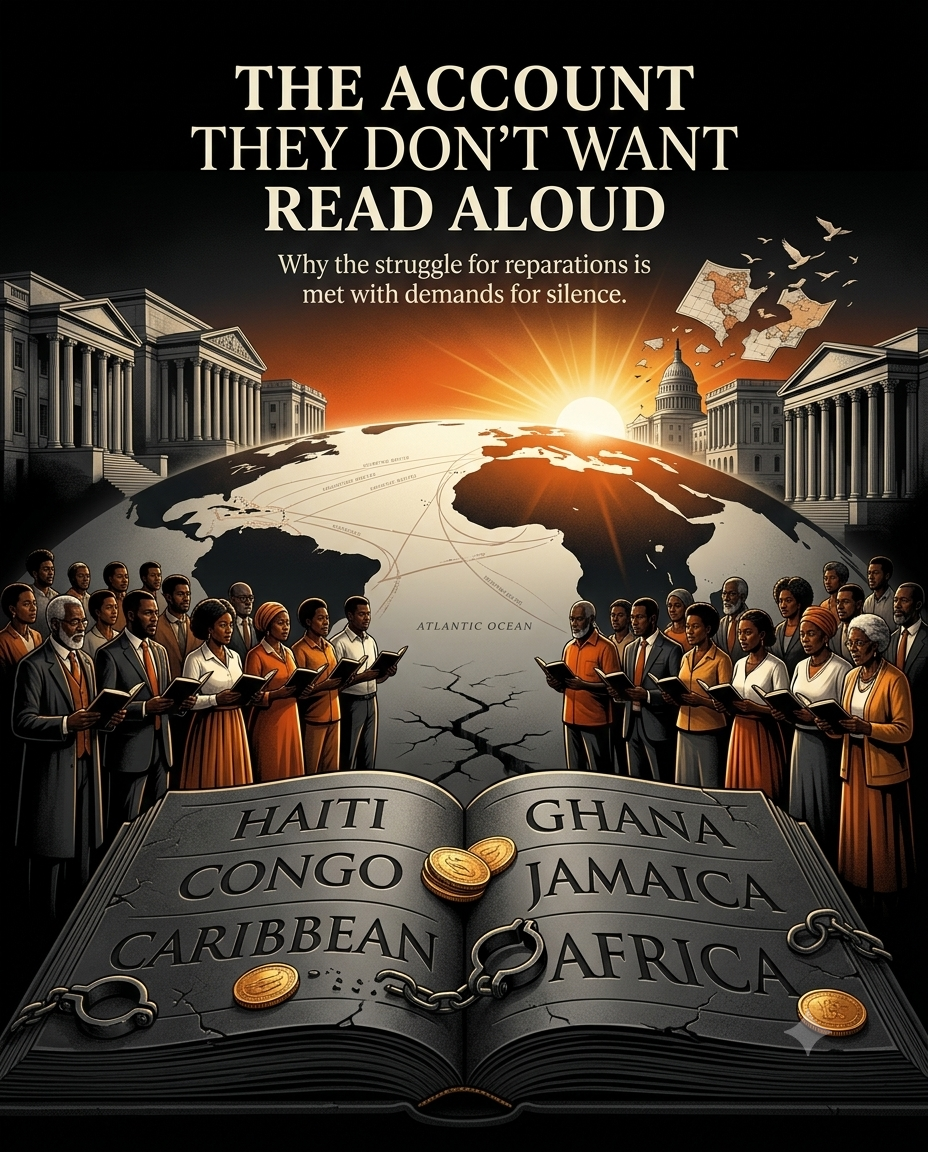
There is a particular tone reserved for Africans and Caribbeans who speak of reparations. It is the tone used for a child interrupting adult conversation, the tone of exasperated patience that says: not this again. Diplomats shift in their seats. Editors reach for the word "divisive." Historians who spent careers cataloguing the ledgers of the slave trade suddenly discover the limits of precision, the impossibility of counting what was stolen. The demand for repair is met, again and again, with a demand for silence dressed up as reasonableness. This is not an accident of tone. It is the last line of defense for a system that has never stopped profiting from the crime it refuses to name.
Consider what is actually being asked. Haiti was forced to pay France for the crime of liberating itself, a debt of independence extracted over more than a century, money that built Parisian boulevards while Haitian schools and hospitals went unbuilt. The Congo was stripped of ten million lives under Leopold's private terror, and the Belgian state that inherited his plunder still lectures the continent on governance. Britain enslaved millions, extracted the wealth of the Caribbean plantation economy, and when abolition finally came, compensated not the enslaved but the enslavers, a debt so large it was only paid off by British taxpayers in 2015. These are not grievances plucked from an aggrieved imagination. They are documented transfers of wealth, labor, and life from the colonized world to the metropoles of Europe and North America. The receipts exist. The vaults that hold them are simply not open to the public.
And yet when the African Union or CARICOM raises the question formally, through commissions, through legal frameworks, through the patient machinery of international diplomacy, the response is not engagement but deflection. Time has passed, they say, as though time absolves theft rather than compounding it through interest, through inherited poverty, through generational dispossession. Ask instead for development aid, they say, offering charity in place of justice, a gift instead of a debt repaid, so that the relationship of benefactor and supplicant can be preserved even as the relationship of thief and victim is erased. The very structure of the refusal reveals what is being protected. It is not the difficulty of calculation. It is the continuity of the arrangement itself, the same extraction under new names, structural adjustment where there was once direct plunder, unequal exchange where there was once forced labor.
This is why the demand for silence is never simply about reparations as a line item. It is about foreclosing the deeper accounting that reparations talk inevitably opens. To seriously discuss what is owed to Africa and the Caribbean is to admit that the wealth of the North was not generated by superior industry or civilization, but by centuries of organized violence against the South. It is to admit that underdevelopment is not a natural condition awaiting the right technical fix, but a produced condition, manufactured by the very powers now offering loans and advice. Walter Rodney named this process decades ago and was assassinated for the clarity of his analysis. The silencing of reparations talk today is continuous with the silencing of Rodney, of Sankara, of every figure who insisted that the wealth gap between North and South is not a mystery of history but a ledger that can be read, if anyone in power were willing to read it honestly.
The demand for quiet also serves a function inside the postcolonial world itself. African and Caribbean elites who make peace with the current order, who trade sovereignty for a seat at summits and a line of credit, have their own reasons to prefer that reparations remain a rhetorical flourish rather than a concrete claim. A serious reparations movement does not stop at the border of the former colonizer. It asks who inherited the plantations, who controls the mines now, who signs the extraction contracts with the same multinational firms whose ancestors ran the slave ships. Reparations, taken seriously, is not a request addressed only outward. It is a mirror held up to comprador arrangements everywhere, and that is precisely why so many governments prefer the symbolic gesture, the apology without transfer, the commission without teeth.
None of this means the demand should soften. The record of the twentieth century shows that colonial powers concede nothing to politeness. Independence was not granted out of moral clarity; it was extracted through armed struggle, general strikes, and decades of organized refusal. The abolition of apartheid was not the product of patient dialogue alone but of boycott, sanction, and the courage of those willing to be called unreasonable. Reparations will follow the same pattern, if it follows any pattern at all. It will not be granted because the argument was finally persuasive enough. It will be won, if it is won, because the movements demanding it built enough power, on enough fronts, in enough countries, that ignoring them became more costly than paying.
So when the question of reparations is raised and the room grows tense, when commentators reach for words like unrealistic or divisive, that discomfort should be read correctly. It is not confusion about history. It is recognition, however unspoken, that the account is real and that someone is finally reading it aloud. The task now is not to soften the demand until it is comfortable for those who owe the debt. The task is to build the collective force, across Accra and Kingston, Nairobi and Port au Prince, that makes the debt impossible to ignore any longer. Silence has never been the natural state of the colonized. It was imposed, and it can be broken.