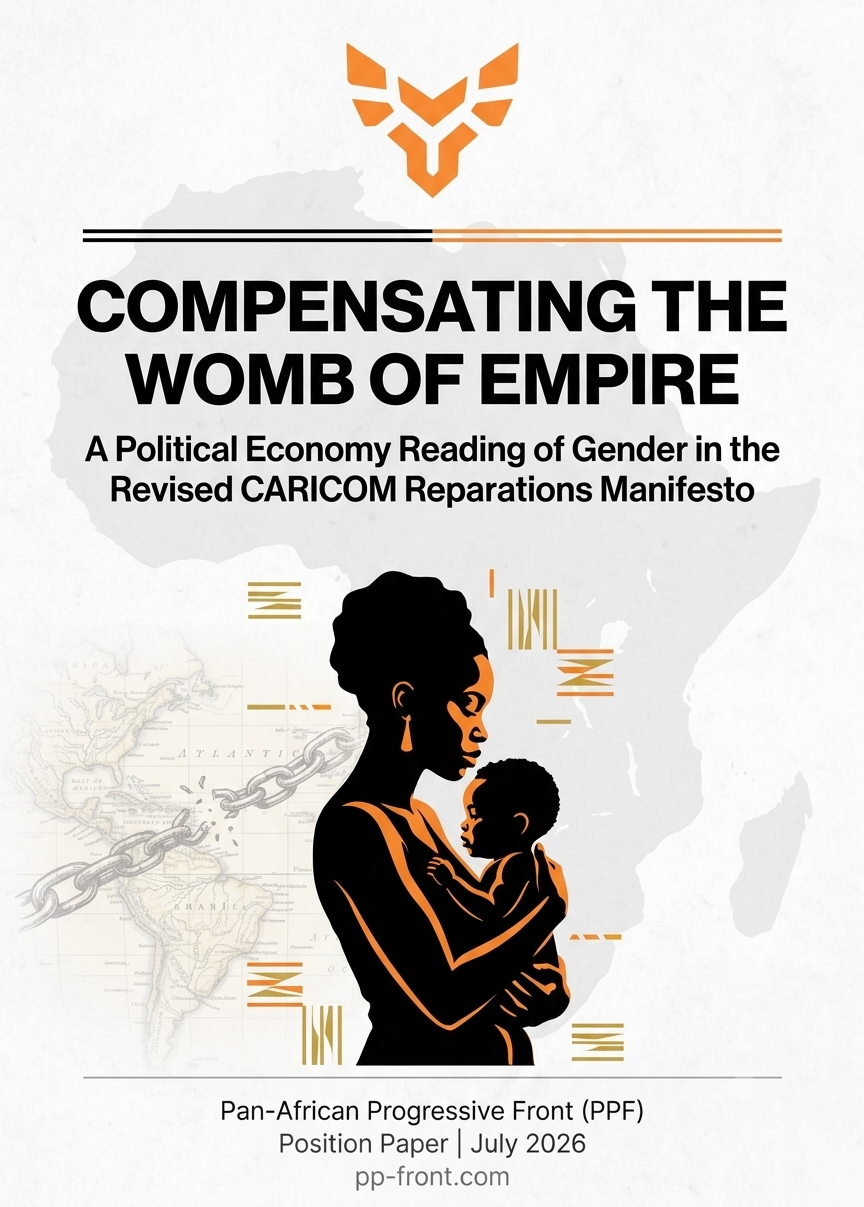
The Pan-African Progressive Front (PPF) has released a position paper examining the gender provisions of the revised Caribbean Community (CARICOM) Ten Point Plan for Reparations, unveiled by Barbados Prime Minister Mia Mottley at the Accra reparations conference in June and subsequently approved by CARICOM Heads of Government.
The paper, titled "Compensating the Womb of Empire: A Political Economy Reading of Gender in the Revised CARICOM Reparations Manifesto," focuses on a provision new to the 2026 manifesto, an explicit and freestanding demand for compensation for gender-based violence and assault on family. The original 2013 ten-point plan treated the harms of enslavement without specific reference to gender. The revised text grounds its new demand in historical data, noting that enslaved women are estimated to have made up roughly three in ten of the twenty million Africans forcibly transported across the Atlantic, with researchers cited in the manifesto estimating that over a million enslaved women endured direct sexual violence.
PPF situates the provision within a wider tradition of left and feminist political economy, arguing that the reproductive lives of enslaved women were systematically appropriated as a source of unpaid future labour, and that the destruction of enslaved families functioned as a deliberate mechanism of economic control rather than an incidental harm.
The paper also sets out a constructive critique. While welcoming the manifesto's grounding of the gender demand in quantifiable data and its legal argument that crimes against humanity carry no statute of limitations, PPF cautions against a settlement that offers monetary compensation while leaving intact the financial and military architecture of neocolonial extraction, including currency arrangements such as the CFA franc and continued foreign military presence across the continent. The paper closes with four demands, including a call for the CARICOM Reparations Commission and the African Union to coordinate the gender provisions of their respective reparations frameworks with sovereignty movements across Africa.
"The gender provisions of this manifesto give the global reparations movement a sharper and more honest vocabulary," said Mr. Humphrey Abbey Quaye, Head of the Pan-African Progressive Front. "Our task is to make sure that vocabulary is placed in service of real structural transformation, and does not settle for the language of apology and cheque."
The position paper follows the United Nations General Assembly's adoption of Resolution A/RES/80/250 in March 2026, which formally declared the transatlantic trafficking of enslaved Africans the gravest crime against humanity, and PPF's own Special Accra Declaration on Reparatory Justice, adopted at the International Conference of Pan-African Progressive Forces in November 2025.
Click the link for the full position paper for download.
For more on PPF's reparatory justice work, visit pp-front.com