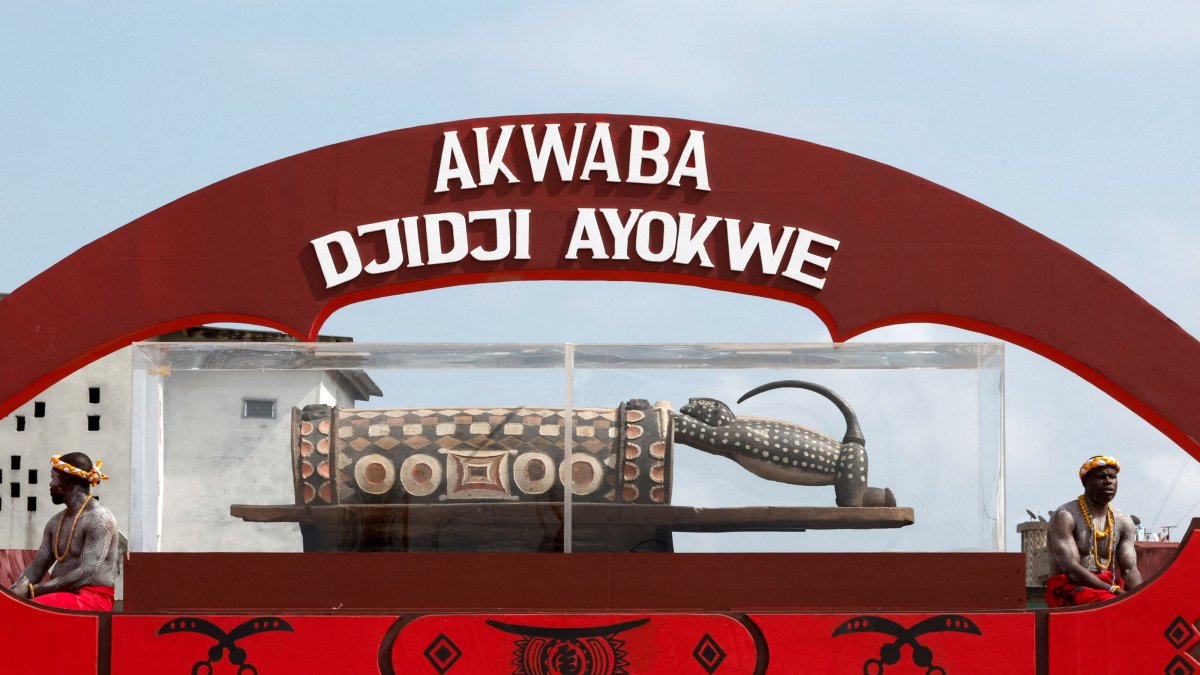
This past week, on Côte d'Ivoire's independence day holiday, the Djidji Ayokwe finally reached the village of Adjame, the ground where it was carved and where, for the first time, today's Ivorians were able to set eyes on it. Carried through the Yopougon district of Abidjan on a decorated float, greeted by traditional leaders, a libation poured for the ancestors, and Culture Minister Françoise Remarck at its side, the drum arrived home more than a century after it was taken. Carved from a single trunk of iroko wood, more than three metres long and weighing close to half a tonne, it was once the voice of a nation, its beats carrying twenty kilometres to summon villages to war, to ceremony, to warning. It was that last function, warning, that sealed its fate. In 1916, when French colonial troops came for forced labour and conscripts, the Djidji Ayokwe sounded the alarm. The colonial administration seized it that same year, silenced it, and shipped it to Paris in 1929 to be displayed as an ethnographic curiosity in the Trocadéro, later the Musée du Quai Branly. A weapon of resistance was turned into an exhibit of conquest. That is the entire logic of the colonial museum in miniature.
It is worth being precise about the sequence, because each stage of this return has been slower and more cautious than the last. The French parliament approved the drum's restitution only after a 2025 vote. It was formally handed over at a ceremony in the Quai Branly in February 2026. It then sat crated in Abidjan from March until this month, unopened, unseen, while officials arranged the choreography of its unveiling. Only this week, timed to coincide with independence day celebrations, was it finally uncrated and carried to Adjame. A century of silence was followed by five more months of a nation waiting to see its own drum.
The homecoming has been celebrated, and celebration is warranted. But it should not be mistaken for justice delivered. It is justice deferred by more than a hundred years, granted in a single case out of the one hundred and forty eight objects Côte d'Ivoire formally requested back in 2018, itself a fraction of the tens of thousands of African artefacts still held in French institutions alone. The drum is the first return under a new French law, passed in May, meant to accelerate restitution. One object, out of an estimated ninety thousand sub-Saharan African items in French public collections. At the pace this represents, full restitution is not a policy, it is a horizon permanently retreating.
It is worth being precise about what is being returned and under what terms, because the language of restitution can quietly launder the politics of theft. These were not gifts, loans, or purchases made in good faith. They were seized at gunpoint, taken during punitive expeditions, extracted under the direct authority of occupying colonial administrations that had already stripped African polities of sovereignty, land, and labour. The Benin Bronzes looted by British forces in 1897 during a retaliatory raid on the Kingdom of Benin. The countless Ashanti gold regalia taken by British troops in successive Anglo-Ashanti wars. Human remains, sacred objects, royal insignia, all removed not as trade but as trophy, catalogued afterward as science and displayed afterward as heritage, Europe's heritage, built from Africa's plunder. When museums today speak of returning these objects, the framing often shifts toward cultural cooperation, joint stewardship, loan agreements, and technical partnership, as though the question were logistics rather than theft. UNESCO's own language around the drum's return spoke of cooperation and dialogue. Cooperation is not the correct word for the resolution of a robbery. Restitution is not a favour extended by a generous former master. It is the minimum discharge of an outstanding debt.
This is why restitution cannot be treated as an isolated cultural gesture, separable from the broader architecture of reparations. The same powers negotiating the slow, item by item return of drums and bronzes are the powers that still extract uranium from Niger, cocoa from Ivory Coast, cobalt from the Congo, on terms set overwhelmingly in Paris, Brussels, and London boardrooms. The CFA franc, until recently pegged and partially controlled through the French treasury, kept fourteen African economies within a monetary architecture designed in Paris. A museum handing back a single drum while multinational firms continue to extract the mineral wealth beneath the ground that drum once stood on is not decolonization. It is decoration.
None of this is reason to dismiss the return of the Djidji Ayokwe. It matters enormously to the Ébrié and Atchan communities for whom the drum is not an artefact but an ancestor, a living presence whose absence was itself a form of colonial violence. What it demands is that solidarity movements refuse to let a single high-profile return substitute for systemic restitution. The struggle is not for the occasional headline object handed back with ceremony and a UNESCO grant attached, useful as public relations for the very states that authorized the original theft. The struggle is for the full inventory to be opened, catalogued honestly, and returned as a matter of right rather than negotiated diplomacy, alongside reparations for the underlying extraction that made these museums wealthy in the first place.
Readers who want to see the scale of what remains held, and to understand the specific histories of individual looted pieces still sitting in European vaults and galleries, can visit pp-front.com/museums, where images and background on a number of these artefacts are collected. It is worth spending time with these objects, not as curiosities but as case files, each one a small dossier of dispossession still awaiting resolution. The drum has spoken again after a century of silence. The task now is to make sure it is not made to speak alone.