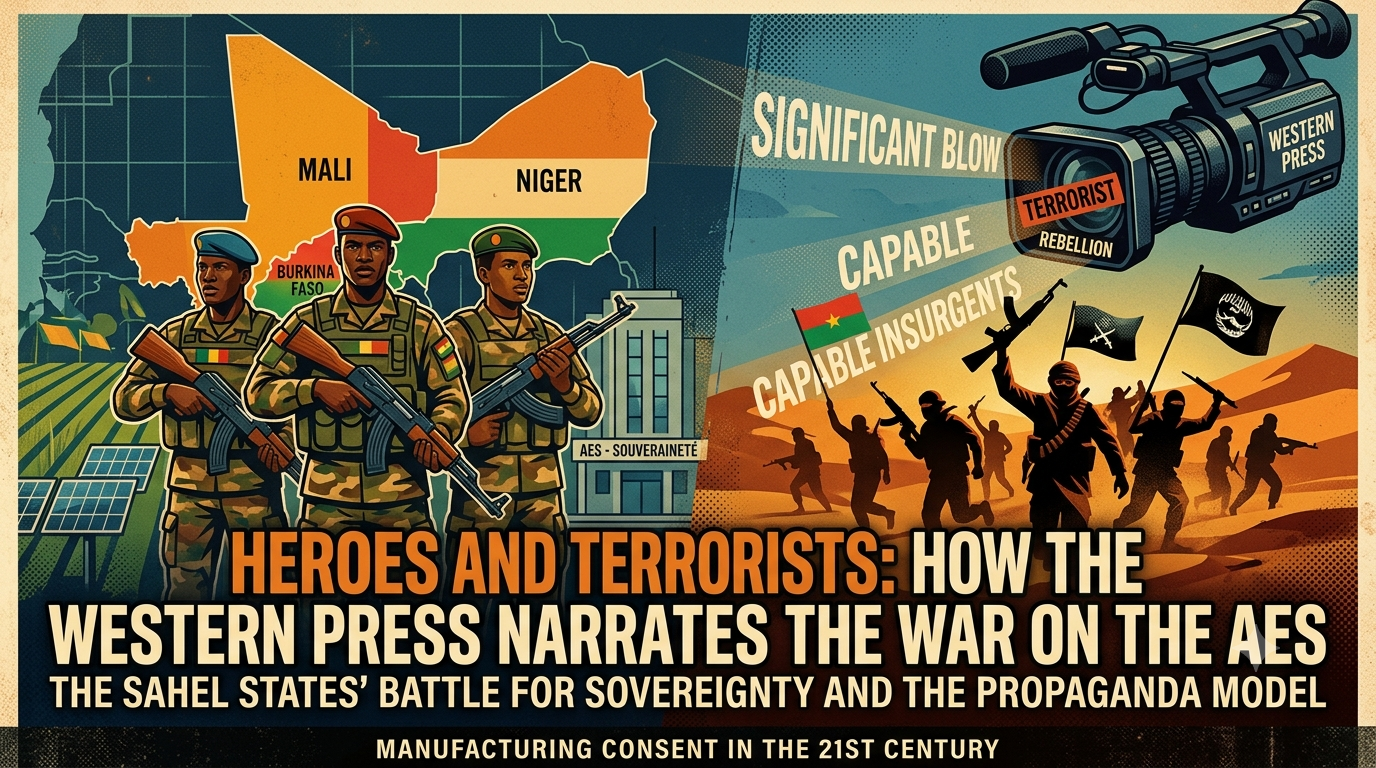
There is a familiar rhythm to how the Western press covers the Alliance of Sahel States, and nowhere is it clearer than in the coverage of the security crisis itself. When separatist and jihadist fighters overran Anefis in early July, days after the simultaneous strikes on Gao, Aguelhok, Sevare and a prison in Kenieroba, much of the international coverage did not read as reporting on an atrocity. It read as reporting on an achievement. Headlines reached for words like unprecedented and significant blow. Analysts queued up to describe the offensive's coordination with near-admiration. Fighters who days earlier had shot a helicopter out of the sky and left twenty-three dead in Kati were rendered, in tone if rarely in explicit language, as capable insurgents besting an overstretched state, rather than as an externally sustained force visiting violence on civilians and soldiers alike. Anyone who has lived through, or studied, the coverage of Cuba after 1959 or of the Soviet Union over seven decades will recognise the cadence immediately. The vocabulary has been updated, but the function has not.
A conjunctural reading of this coverage has to start where the left has always started with media analysis, not with the individual bias of this or that correspondent, but with the structure that produces the coverage in the first place. Edward Herman and Noam Chomsky's propaganda model remains, decades on, the sharpest tool available for this task, precisely because its five filters, ownership, advertising, sourcing, flak and ideology, map so cleanly onto the machinery now trained on Mali, Burkina Faso and Niger.
Start with ownership. The outlets setting the international frame on the Sahel, the wire services, the legacy broadcasters, and the major dailies are not neutral conduits. They sit inside conglomerates with defence, mining and finance interests threaded through their boards and shareholder registers, the same class of capital that has watched French, and to a lesser extent American, extractive and military footholds in West Africa erode since 2020. A press corps structurally tied to that capital does not need an editorial memo to know which side of the Sahel's realignment is the story of decline and which is the story of stability. The framing is downstream of ownership before a single journalist boards a plane.
Advertising does the rest of the sorting. Outlets dependent on corporate advertising and on audiences cultivated as consumers, not citizens, have every commercial incentive to produce coverage that does not unsettle the advertisers or the governments those advertisers are close to. Sober reporting on AES states building independent food, energy and security capacity, capacity that by definition reduces dependence on Western firms, does not serve that model. Coverage of instability, coups, and the pursuit of Russian mercenaries does. It is not an accident which of the two dominates the front page.
Sourcing compounds the distortion, and the reporting on Anefis and Gao is a case study in how. Reporters on tight deadlines lean on cheap, credentialed, English or French speaking sources, which in practice means Western defence ministries, NATO adjacent think tanks, exile networks tied to the separatist cause, and the diplomatic circuit in Paris, Brussels and Washington. Those sources supplied the language of momentum and gains that so much coverage adopted uncritically. Bamako's own briefings, and the accounts of Malian and allied soldiers who held the line for days before repositioning, appear as quotations to be managed, not as the frame itself. This is the same asymmetry that let Cold War coverage treat the State Department as fact and Havana as propaganda to be balanced against it.
Flak, Herman and Chomsky's fourth filter, is the mechanism that keeps journalists and editors from straying too far from that frame. A newsroom that described the Kenieroba prison assault or the Kati deaths in the same register normally reserved for atrocity would risk little. A newsroom that named the Azawad Liberation Front and JNIM's coordinated offensive plainly as terrorism, or that questioned who was arming and directing it, invites swift accusations of parroting Kremlin talking points, regardless of the argument's merits. The charge of disinformation has become the flak of this era, deployed not to establish truth but to raise the reputational cost of dissent, exactly as charges of being a fellow traveller once did. The asymmetry is telling: coverage need not praise the fighters outright to launder them, it need only decline to call them what they are while reserving its harshest language for the government defending against them.
The fifth filter, anti-communism as Herman and Chomsky originally named it, has simply been renamed. Where the ideological glue once holding the propaganda system together was anti-communism, it now presents as a diffuse but no less potent anti-authoritarianism, invoked selectively enough to leave Gulf monarchies and Western-aligned juntas untouched while falling with full force on any Sahelian government that partners with Moscow. The content of the label changes with the geopolitical moment. Its function, manufacturing consent for the isolation of states that step outside the Western-led order, does not.
None of this is unique to Africa's present moment. It is the same commodified, advertiser-dependent, ownership-concentrated media system that spent decades manufacturing the Soviet Union as an existential menace and Cuba as a totalitarian basket case, in both cases obscuring the material interests, markets, resources, strategic basing, that Western capital stood to lose from their independence. The AES states and their Russian partnership are simply the present tense of a much older sentence.
Recognizing the machinery does not disarm it on its own. What it does is clarify the task. The left across Africa and its diaspora needs an independent, pan-African media infrastructure that is neither owned by the capital it should be scrutinizing nor dependent on the advertising logic that manufactures consent for empire. Solidarity with the AES, like solidarity with Cuba before it, has always required seeing through the propaganda system to the material interests it protects, and building the capacity to tell the story ourselves.