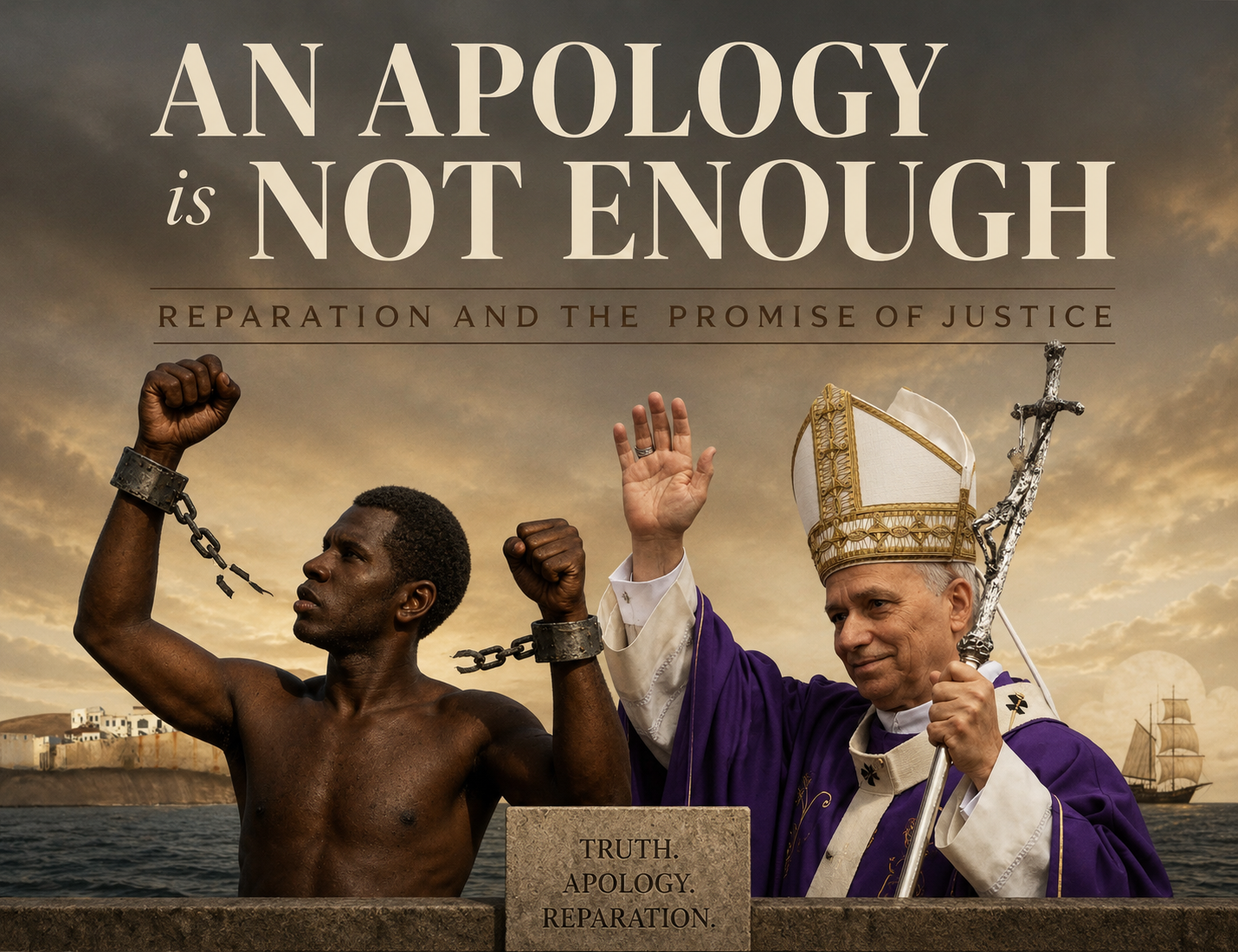
On May 25, 2026, Pope Leo XIV did something no sitting pope had ever done before him. In his first encyclical, Magnifica Humanitas, he formally acknowledged that the Holy See itself played an active and institutional role in legitimizing the transatlantic slave trade. Not individual Christians. Not wayward missionaries in distant provinces. The papacy. The institution. He called that record “a wound in Christian memory.” He apologized.
This matters. It would be dishonest to pretend otherwise, and serious criticism has no use for reflexive cynicism when something genuinely shifts. But welcoming this moment and interrogating it are not contradictory acts. They are both necessary. Because the deeper one looks at this apology, the clearer it becomes that what Leo XIV has offered is the beginning of a moral ledger, not its settlement. An apology without material consequence is a theological gesture. History demands something sturdier.
On the Nature of this Admission
Previous papal statements on slavery placed the Church in the position of aggrieved observer, an institution whose teachings were betrayed by sinful individuals. The language was always distancing: Christians did this. Leo XIV has broken from that tradition in a way that cannot be understated. He acknowledged that popes themselves handed European sovereigns the explicit theological and juridical authority to enslave entire peoples.
Within Catholic ecclesiology, papal authority is not simply administrative. It is held to derive from divine mandate. When a pope says that prior popes authorized slavery, he is not saying that some bureaucrats made poor policy choices. He is saying that the Church’s most sacred office was deployed in the service of one of history’s gravest crimes. That admission carries structural weight.
Leo also placed this reckoning within a broader critique of exploitation, drawing a direct line from the slave trade to contemporary forced labor, human trafficking, and the supply chains of rare minerals that undergird the artificial intelligence economy. It is a genuinely serious gesture, rare for a sitting pope, and it refuses the comfortable fiction that slavery belongs only to the past.
And yet. The apology appears as a passage inside an encyclical whose primary subject is artificial intelligence. For the peoples of Africa, for the descendants of the enslaved across the diaspora, for the Indigenous communities of the Americas whose lands were seized under the same theological sanction, the question is not whether the words are sincere. The question is whether they are structurally meaningful.
The Bulls That Built the World
On June 18, 1452, Pope Nicholas V issued the papal bull Dum Diversas. The document authorized King Afonso V of Portugal to invade, capture, vanquish, and subdue Saracens, pagans, and all enemies of Christ, and to reduce their persons to perpetual servitude. This was not the language of theological abstraction. It was a license: the founding document of the Atlantic slave trade, issued from the seat of Western Christendom, wielded as an instrument of political economy.
Three years later, in 1455, Nicholas V issued Romanus Pontifex, which extended Portugal’s dominion over all lands “discovered” along the African coast and beyond, sanctifying not only the enslavement of their inhabitants but the wholesale seizure of their territories and resources. Non-Christian peoples had no property rights, no sovereign claims, and no standing before the law of nations that the papacy had arrogated to itself the authority to write. Slavery and dispossession were not corruptions of this framework. They were its intended products.
These two documents, together with Pope Alexander VI’s Inter Caetera of 1493, which partitioned the entire non-Christian world between Spain and Portugal as though it were an estate to be divided, form the juridical spine of the Doctrine of Discovery: the body of theological and legal reasoning that justified five centuries of colonial plunder, indigenous dispossession, and racial chattel slavery across two hemispheres.
What makes the history still more damning is its deliberate continuity. The permissions granted in these bulls were not the impulse of one man. They were confirmed by Pope Callixtus III in 1456, by Pope Sixtus IV in 1481, and by Pope Leo X in 1514. This was not error. It was policy, renewed and ratified across generations of papal succession.
In 2023, the Vatican formally repudiated the Doctrine of Discovery. In 2026, Pope Leo XIV has apologized for the bulls that gave it birth. But the Vatican has never formally revoked, abrogated, or nullified those bulls. They remain on the books. The Vatican argues that a later bull, Sublimis Deus of 1537, functionally supersedes the earlier documents. This argument does not hold. A subsequent affirmation of dignity does not retroactively cancel centuries of harm carried out under the earlier license. A government that apologizes for a law while keeping it on the books has not repealed the law. It has managed its optics. Revocation is not symbolism. It is the minimum precondition for sincerity.
The Question of Wealth
The apology does not touch the question that sits at the heart of any serious reckoning: what the Church accumulated, and how. The Catholic Church is among the largest institutional landowners on earth. Its accumulated wealth, distributed across real estate, art, financial holdings, universities, and hospitals spanning every continent, represents one of the most extraordinary concentrations of institutional capital in human history. How much of that wealth traces directly or structurally to the labor of enslaved peoples, to the resources extracted from colonized territories, or to the economic surplus of institutions the Church blessed and administered, has never been honestly audited. That silence is not neutral. It is a position.
The Jesuits offer the most documented window into this history. Their plantations in the antebellum American South operated for more than a century on enslaved labor. In 1838, the Jesuit owners of what is now Georgetown University sold 272 enslaved people to Louisiana plantation owners to keep the university financially viable. The enslaved were not peripheral to Georgetown’s existence. They were its economic foundation. In 2021, the Jesuit Conference of Canada and the United States pledged $100 million in reparations to the descendants of those 272 people. The descendants, rightly, identified one billion dollars as the appropriate figure.
Georgetown is one institution. The Jesuits are one order. The broader Church, which provided the theological license and, in many cases, the direct administrative apparatus for the entire slave system across two hemispheres, has offered nothing comparable. An apology unaccompanied by material redress is, in the end, a continuation of the original injury by other means.
What Accountability Requires
It begins with the formal nullification of Dum Diversas, Romanus Pontifex, and Inter Caetera: not as a gesture of repudiation but as a legal abrogation with explicit acknowledgment of the harm these documents enabled. If the Church insists these bulls are merely historical curiosities, there should be no resistance to formally and permanently striking them from the canonical record.
It requires the establishment of an independently audited reparations mechanism, administered not from Rome but with genuine governance from the communities whose ancestors and territories were plundered under these bulls: the peoples of sub-Saharan Africa, the Indigenous nations of the Americas, and the communities of the African diaspora worldwide. Reparations are not charity. Charity is given at the discretion of the donor. Reparations are returned because they were taken.
It demands a full, independent historical audit of the Vatican’s accumulated wealth, tracing with scholarly rigor what portion is traceable to the slave economy and colonial extraction. The institution itself cannot conduct this audit. It requires scholars selected by and accountable to the affected communities.
And the Vatican Archives must be opened: centuries of correspondence, financial records, and administrative documents relating to the Church’s relationship with the slave trade and colonial administrations. Historical accountability cannot be managed from behind closed doors.
Conclusion
Pope Leo XIV has moved. The acknowledgement that the papacy itself, not a collection of straying individuals but the institution, authorized the enslavement of millions, is a moral concession of real weight. Scholar Christopher Kellerman, who has studied this history closely, noted that Leo has strengthened the Church's moral credibility with this admission.
But moral credibility and structural accountability are different currencies. The bulls are still on the books. The wealth built on enslaved labor remains undistributed. The archives remain controlled. The hierarchy remains structured along lines the colonial period created. An apology that changes none of these conditions is, in the end, a way of narrating the past rather than confronting the present.
The Catholic Church was not merely a participant in the world order that colonial capitalism produced. It was one of its architects. The poverty of the Global South is not a natural condition. The wealth of Western Europe and its settler-colonial offshoots is not the fruit of superior industry. These are the legible outcomes of a system the Church helped design, bless, and administer for five centuries. Acknowledging that system is necessary. Dismantling its residue is the obligation that follows.
The words were necessary, Pope Leo. Now the world awaits the work they require.