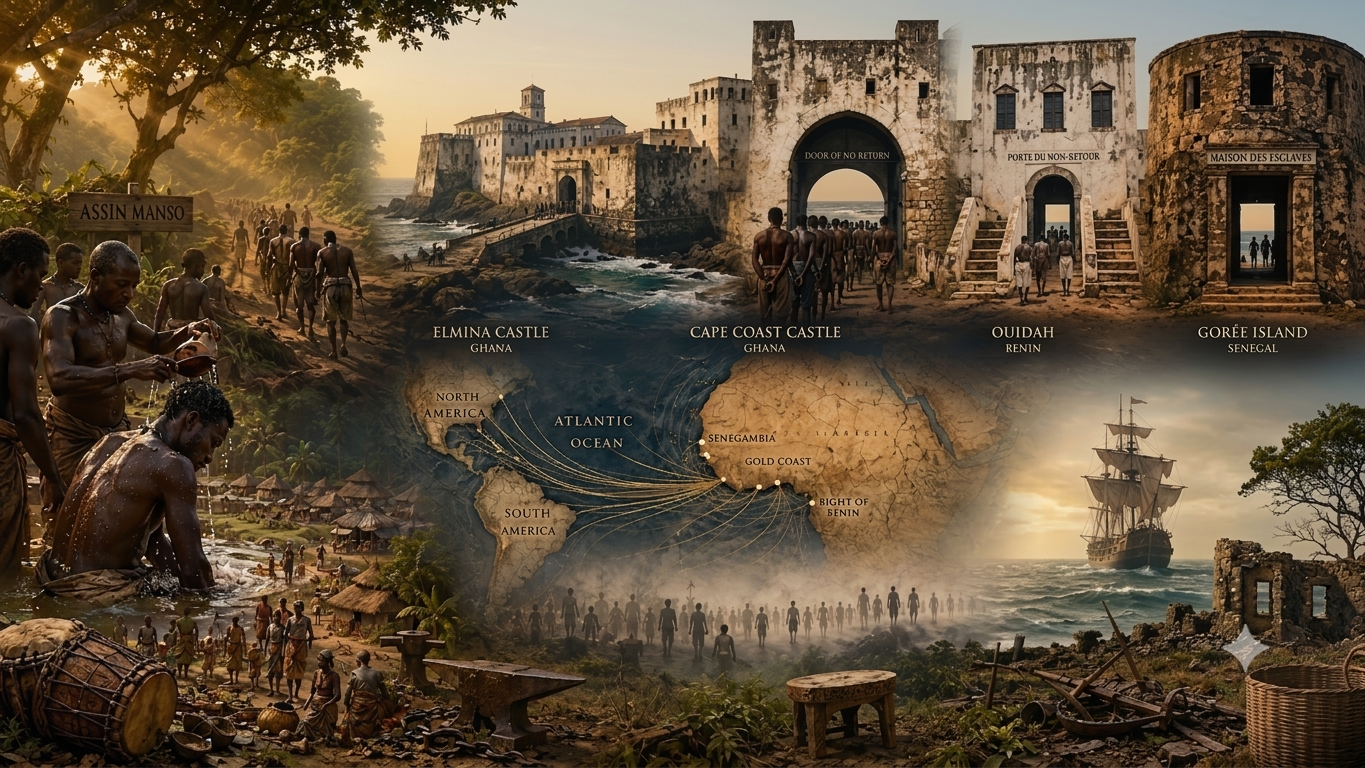
At Assin Manso, a slow river still moves past the site where captives took their last bath before the march to the coast. It was, in the language of the trade, a preparation, a cleansing before sale, as if humanity could be rinsed off a person before they were priced. From there the chain of captivity ran to the dungeons of Elmina and Cape Coast Castle, to Ouidah's Door of No Return, to the granite cells of Gorée Island. These sites are usually remembered as monuments to cruelty. They should also be read as nodes in the largest forced demographic transfer in recorded history, one whose scale rivals and arguably exceeds the destruction wrought by plague or war, and whose consequences did not end when the ships stopped sailing.
The numbers alone demand a reckoning beyond moral horror. Historians differ on totals, and the disagreement itself is instructive. Philip Curtin's early census put transatlantic arrivals near ten million. David Eltis and the Trans-Atlantic Slave Trade Database later revised the figure upward, past twelve million embarked, with mortality on the Middle Passage alone claiming well over a million lives before landfall. Patrick Manning went further, arguing that counting only those who survived to embark badly understates the demographic wound, since war, capture, and the march to the coast killed as many or more within Africa than the crossing killed at sea. Joseph Inikori has shown that the trade's demand structure did not simply remove surplus population but actively incentivized raiding economies that consumed young, economically productive men and women, precisely the cohort whose absence does the most lasting harm to a society's capacity to reproduce itself, till its land, and staff its institutions.
This is the heart of the demographic catastrophe argument. A population loss is not simply subtraction. When war parties and raiding states targeted people in their most fertile and productive years, they did not just remove individuals, they removed decades of future births, future harvests, future craftsmen and rulers. Nathan Nunn's quantitative work, linking regions of heaviest slave extraction to measurably lower economic performance today, suggests this was not a wound that closed. Regions most exposed to slaving, controlling for other factors, show weaker levels of trust, thinner state capacity, and shallower material development centuries later. Correlation is not causation, and Nunn is careful to say so, but the pattern holds across enough independent measures, ethnic fragmentation, interpersonal trust, formal institutional strength, that dismissing it as coincidence requires more faith than the evidence supports.
Walter Rodney's contribution was to insist that this depopulation was not incidental to European enrichment but structurally bound to it. In his account, the wealth accumulated in Bristol, Liverpool, Nantes, and Lisbon was not merely traded for African captives, it was substantially built from the profits of that trade and the plantation economies it fed. Paul Lovejoy's synthesis of the internal African slave economies complicates any simple morality tale, showing that indigenous institutions of bondage existed prior to and alongside the Atlantic trade. But Lovejoy is equally clear that the scale, commercial logic, and export orientation of the Atlantic system had no real precedent, and that European capital, ships, firearms, and credit transformed local practices of servitude into an industrial engine of extraction aimed outward across an ocean.
It is worth pausing on the revisionist claim that African participation in capturing and selling captives dilutes European responsibility. This argument mistakes the presence of local intermediaries for equivalence of power. African merchants and rulers who supplied captives operated within a system whose terms, prices, firearms supply, and demand volume were set in London, Lisbon, and Amsterdam. Coercion and calculation coexisted, as they do in most historical systems of extraction, but the architecture belonged to the European trading companies and the states that chartered them. Distinguishing agency from structural power is not moral evasion; it is the basic discipline of historical analysis.
The costs did not stay confined to the ledger of lost lives. Joseph Miller's study of Angola describes how slaving warfare militarized political life, rewarding rulers who could capture and sell rather than those who could govern and build. Kingdoms reorganized around raiding rather than agriculture or craft production. Indigenous industries, textile production in parts of West Africa, ironworking traditions elsewhere, withered as demographic and political energy was redirected toward supplying a foreign market in bodies. Meanwhile, across the Atlantic, the profits of sugar, cotton, and tobacco financed the banking houses, insurance markets, and industrial ventures of Britain's early manufacturing economy. Eric Williams's older thesis, that Caribbean slave profits helped capitalize the Industrial Revolution, remains contested in its particulars, but the broader claim, that Atlantic slavery and African depopulation were structurally entangled with European industrial takeoff, has only gained empirical support since he wrote it.
None of this argues that colonialism was a lesser crime, or that the nineteenth-century scramble for Africa can be understood in isolation from the centuries that preceded it. It argues the opposite, that colonial conquest fell upon societies already demographically hollowed out, their political structures already reoriented by generations of externally driven raiding, their institutional development already interrupted before a single European flag was planted on the coast. Reparatory justice conversations that begin only with colonial administration miss this deeper layer. The wound of the slave trade was not simply violence done to individuals, terrible as that was. It was the removal, over four centuries, of the human capital that a continent needed to build states, industries, and institutions on its own terms and timeline.
Standing at Assin Manso today, what should be remembered is not only cruelty but architecture, a system engineered with commercial precision to extract exactly what a rising Atlantic economy needed most, and to leave behind exactly what that economy did not, a demographic and institutional deficit whose outline is still visible in the data, and whose reckoning remains unfinished.