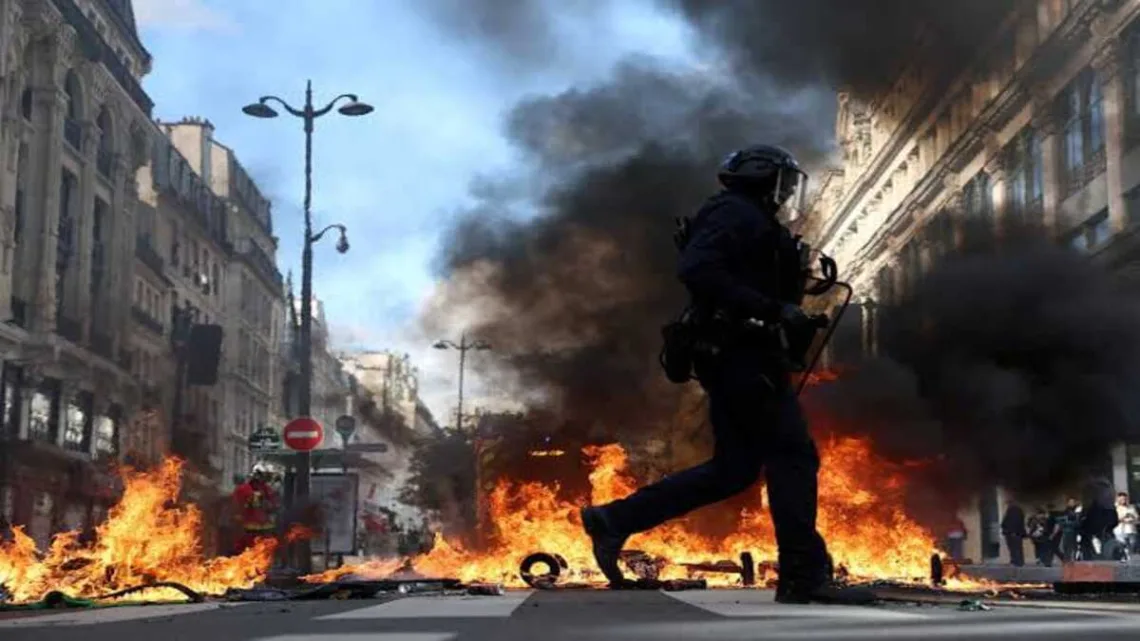
For years, a familiar script has accompanied youth protest in the Global South and in states the West dislikes. The cameras arrive, the language is generous, and the story is one of a generation reclaiming its future from an unaccountable order. Tear gas is called repression. Arrests are treated as proof that a government has lost legitimacy.
Now look at Europe this October.
The facts on the ground
What began as high school blockades in France has spread to Belgium, Albania, Greece, Spain and Italy. Students have occupied schools in Turin and Rome. Teachers in the Madrid region have launched an indefinite strike. In Brussels and Liège, students and police have clashed almost daily over budget cuts and tuition reforms. On 6 October, France’s interior ministry counted more than 250,000 marchers, while organisers put the figure near 450,000. In Tirana, students threw bricks at the education ministry and police responded with tear gas and water cannon. The French government has suspended the use of stun grenades against protesters.
The grievances are concrete: crumbling classrooms, teacher shortages, rising education costs, unaffordable housing and graduates facing a thin job market. These are the same complaints young people voice everywhere.
The vocabulary test
Imagine the same footage from Nairobi, Kathmandu, Tehran, Minsk or Moscow. The headline would read "Gen Z uprising." Western foreign ministries would "stand with the young people." Commentators would write about a generation losing faith in a failing system.
When the footage comes from Paris, Brussels or Tirana, the words change. The coverage speaks of "unrest," "disorder" and "clashes," followed by a measured account of the government's "response." Students who confront police in Africa are courageous. Students who confront police in Europe are a public-order problem.
European governments are elected, and that matters. But it makes the inconsistency harder to defend, not easier. A standard that applies only when the protesters live somewhere inconvenient to Western governments is a political tool, not a principle.
The boomerang
For two decades, Western governments, foundations and media have celebrated street movements abroad as the natural voice of civil society, and have often funded and amplified them. The underlying assumption was that mass youth anger signals a failing system.
Applied consistently, that logic describes Europe today: a generation squeezed by austerity, high rents and underfunded schools, facing a political class that speaks of democracy more often than it delivers security. Europe has promoted this kind of movement abroad for years. It is now facing it at home.
The temptation to look elsewhere for an explanation is already visible. Misleading videos have circulated to exaggerate the violence in France, which makes it easier to blame disinformation, outside agitators or “extremism” than to discuss tuition, rent and classroom shortages. When protests happen in other countries, the cause is the government. When they happen at home, someone else must be to blame.
What Europe should take from this
Young people everywhere protest for the same reason. They were promised a future and handed a bill. African youth do not need a European press release to know their grievances are real, and French or Albanian ones do not either.
If Europe wants credibility when it lectures others on civic freedoms, it should start by applying the same standard to its own streets. That means listening to protesters, investing in schools and housing, and describing dissent in the same terms wherever it happens.