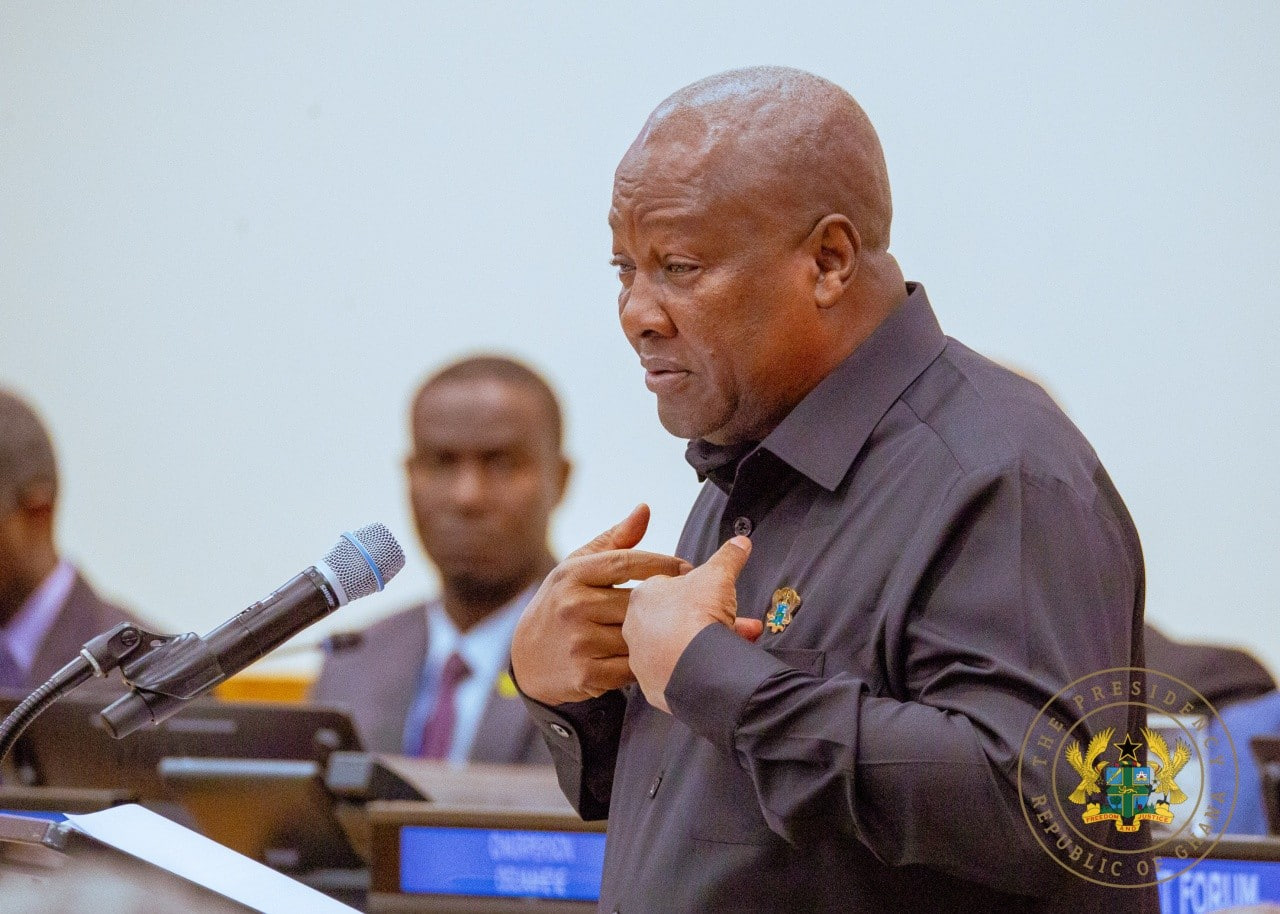
Hours before the United Nations General Assembly was scheduled to vote on one of the most consequential resolutions in its nearly eighty-year history, Africa and its diaspora gathered at UN Headquarters to do what five centuries of imperial silence had resisted: to name the trafficking and enslavement of Africans by its proper name, to trace the unbroken line from the dungeons of Cape Coast Castle to the structural inequalities of the present, and to serve notice that the demand for reparatory justice has moved from moral appeal to organised political action.
The High-Level Special Event on Reparatory Justice for the Trafficking of Enslaved Africans and the Racialized Chattel Enslavement of Africans, convened on Tuesday March 24, 2026, brought together heads of state, African Union officials, CARICOM representatives, scholars, civil rights activists, and diaspora leaders. It was chaired by Osabarima Kwesi Atta II, the paramount chief of the Cape Coast Traditional Area in Ghana's Central Region, a man who has personally guided the likes of President Obama, President Clinton, Vice President Kamala Harris, and countless civil rights activists through the very forts and castles from which millions of Africans were shipped into bondage.
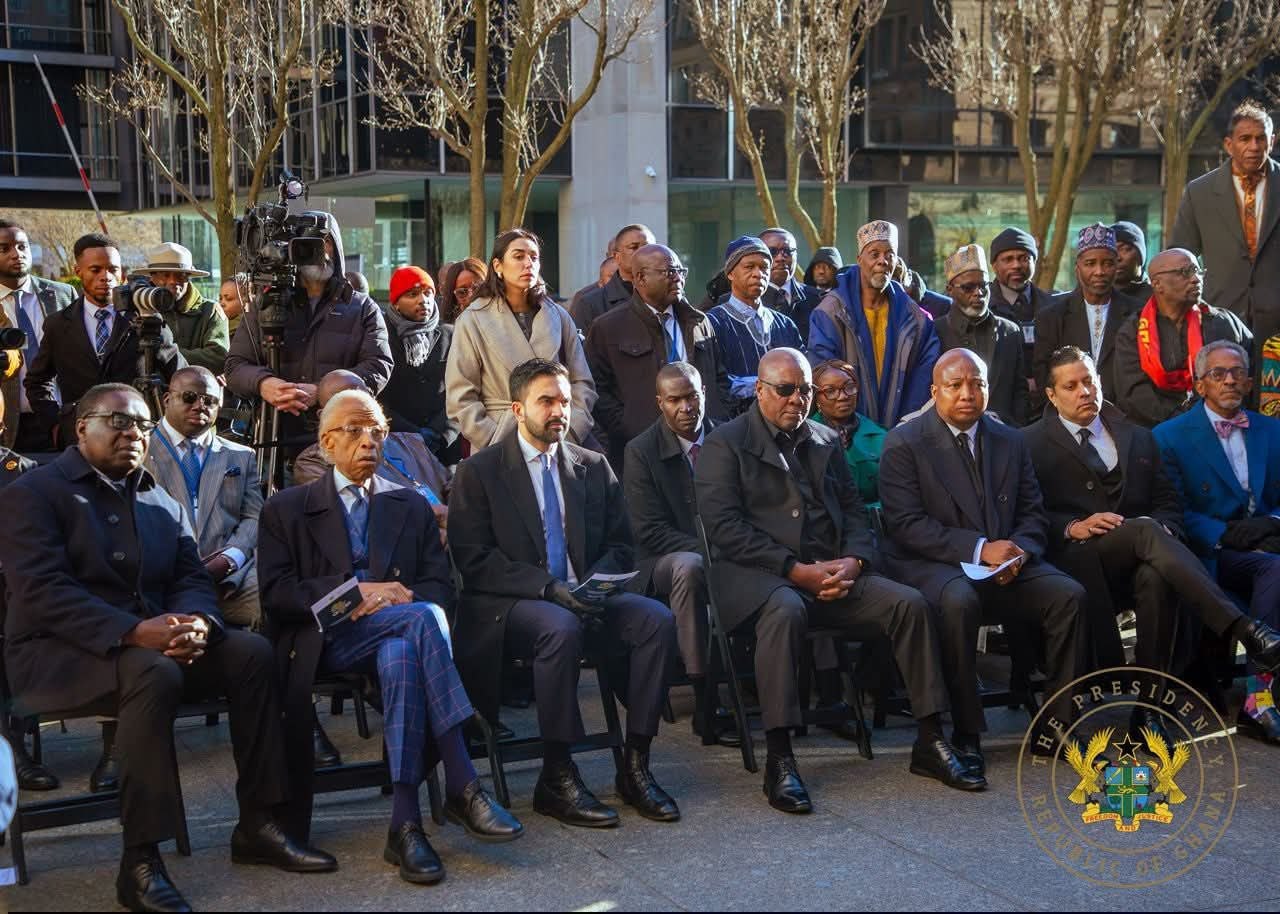
The event opened with solemnity. Earlier that morning, Ghana's President John Dramani Mahama, serving as African Union Champion on Reparations, led a wreath-laying ceremony at the African Burial Ground National Monument in lower Manhattan, where the remains of enslaved Africans lie beneath the streets of the city that built much of its early financial power on the profits of that same enslavement.
"Truth Begins with Language"
When President Mahama took to the podium for his keynote address, he opened not with diplomatic pleasantries but with a deliberate act of linguistic reclamation, one that set the terms for everything that followed. "Truth begins with language," he told the assembled delegates. "There is no such thing as a slave. There were human beings who were trafficked and then enslaved by people who believed they could own those human beings as chattels, as their personal property."
It was a provocation rooted in precision. The renaming was not semantic. It was political. For centuries, the vocabulary of enslavement had been shaped by those who designed and profited from the system. The word "slave" naturalises bondage, stripping the person of their prior humanity and freedom. Mahama's insistence on "enslaved African" restores both. "The entire transatlantic slave trade was designed to deny African people their humanity," he continued. "And that denial was premised on a racial hierarchy with no basis in fact or science, a racial hierarchy that deemed whiteness superior and blackness inferior."
He walked the audience through the full horror of what that racial hierarchy produced in practice. The stripping of clothing in the dungeons of coastal forts. The chaining of limbs. The loading of human beings like cargo into the holds of ships. "They remained naked, packed like sardines during the month-long journey through the Middle Passage," he said. "Not all those who were loaded onto the ships survived the voyage. A number of the ships sunk with their entire human cargo. Others who fell sick were thrown overboard."
He recounted what awaited those who survived. "Whenever a ship arrived at its destination, the enslaved people, still naked, were taken to the market where they were inspected and appraised like livestock. They were then placed on an auction block in front of an audience of potential buyers and sold to the highest bidder."
And then, on the plantation: "You were no longer Fati or Kofi or Bubakar or Naomi or Hamisu. You were given names like Ben, Jimaima, John, Toby, or Mary. In addition to these new names, they were also called girl or boy, regardless of how old you were."
The Scale of a Crime
President Mahama placed specific numbers before the assembly, insisting repeatedly that the figures represent human lives and not data points. Roughly six million enslaved Africans were trafficked through Brazil. Nearly two million were trafficked to Jamaica, which he described as "the most profitable of all sugar producing locations." Around half a million were trafficked to the United States from the early seventeenth century to abolition. Over 450,000 were trafficked to Barbados, an island just thirty-four kilometres long and twenty-three kilometres wide. It was in Barbados that the legal architecture of chattel enslavement was first formally codified. In 1661, the island's colonial legislature enacted a slave code whose preamble described Africans as "a heathenish, brutish, an uncertain, dangerous kind of people." The code gave plantation owners and overseers, in Mahama's words, "the ability to torture, maim, and even kill enslaved Africans with impunity, and became something of a template for the rest of the Anglo-Atlantic world."
A year later, in 1662, the colony of Virginia enacted the legal doctrine known as Partus Sequitur Ventrem, which the President translated from Latin as "what is born follows the womb." This legal framework ensured that all children born of enslaved women would automatically be enslaved, regardless of paternity, and regardless of whether the child was the product of rape by a plantation owner or overseer. As Mahama noted, it stripped the child of paternity in the eyes of the law: "That child as an enslaved person was property that could be given or sold at its owner's whim."
Those who argue that the moral standards of today cannot be applied to the past were given short shrift. "Such people are loud and wrong," Mahama said. "Just because everybody is doing something doesn't make it right. Slavery is wrong now and it was wrong then. For as long as Africans have been trafficked and enslaved, there have been abolitionists who have spoken up against it."
The Structural Diagnosis
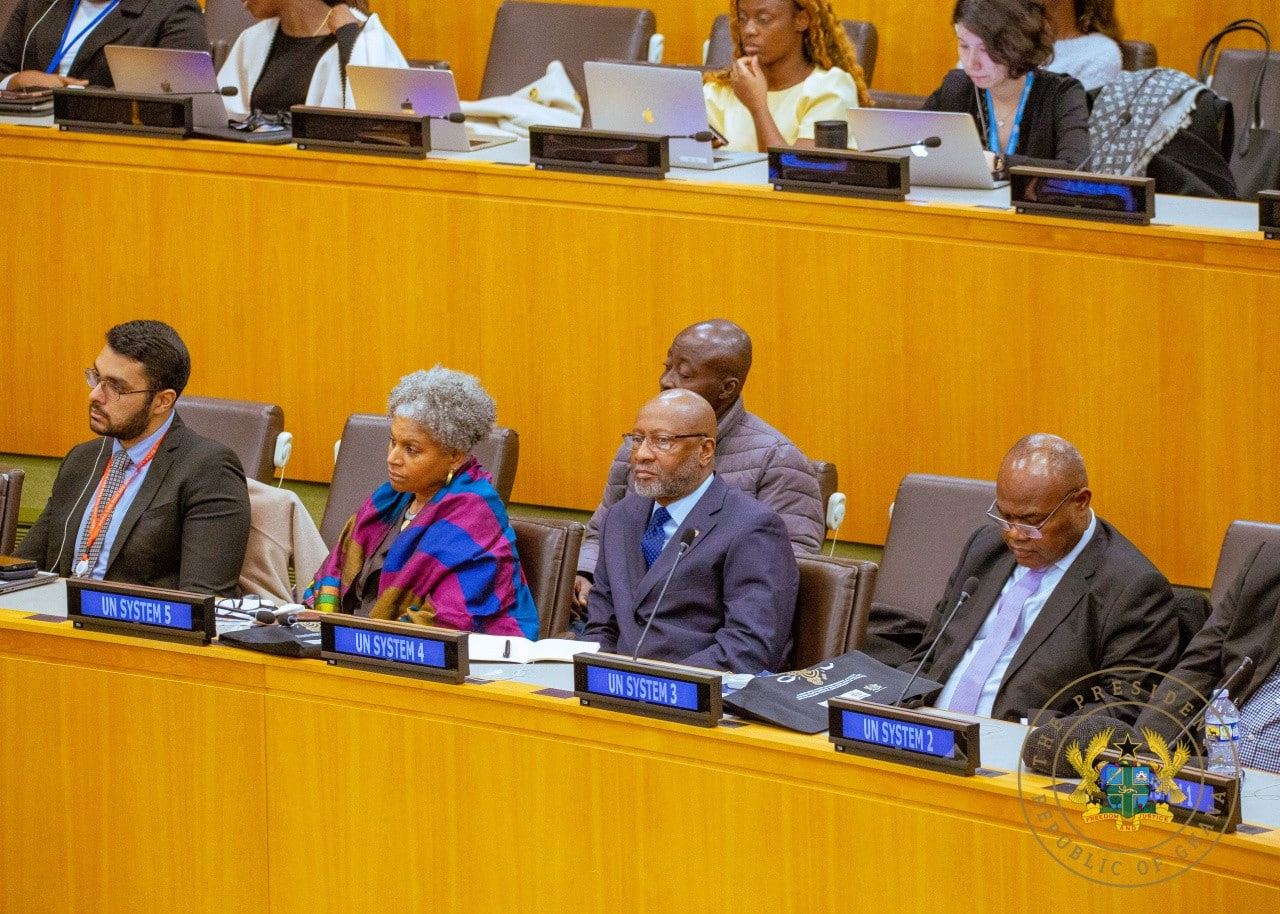
The event was designed not merely as ceremony but as intellectual confrontation. A distinguished panel of scholars was tasked with making the structural case for why the trafficking in enslaved Africans constitutes a rupture unlike any other in the history of the modern world.
Dr. Panache Chigumira, a Zimbabwean historian serving as Rapporteur of the African Union Committee of Experts on Reparations, grounded the proceedings in the Ubuntu philosophy that underpins the AU's entire reparations framework: "It never happens that the hippo's child is eaten by the crocodile and the pool remains still. There must be consequences. There must be historical accountability."
She took direct aim at the intellectual gatekeeping of Western academia. In 1776, Adam Smith declared in The Wealth of Nations that the rounding of the Cape of Good Hope and the so-called discovery of the Americas were the two most important events in human history. Yet Smith named geography, navigation, and global commerce while refusing to name what made all of it possible. "Adam Smith saw the world that the crime built and he described it as if the crime had never happened," Dr. Chigumira said. "Without it, there was no capital to finance the voyages, no labor to extract the wealth, no system to sustain an empire. The ship's route was not the rupture. The enslaved bodies in the hull were."
The structural consequences, she argued, reached every corner of the globe. In the Americas, indigenous peoples were dispossessed and eliminated to clear the land, enslaved Africans were forced to extract its wealth, and communal territories were recast as private property, "hardwiring racial domination into the foundations of modern capitalism." In Europe, plantation capital funded the Industrial Revolution. In Asia, Atlantic profits financed the conquest of India and the Opium Wars in China. In Africa, the removal of entire productive generations "shattered sovereignty, militarized economies, and lay the ground for the scramble for Africa."
"Slavery was not a metaphor," she said. "It was the blueprint for development, both before and after abolition."
Professor Idim Adoce of the University of Ghana's Institute of African Studies reinforced the point that the system was not an accident of circumstance but a deliberate institutional construction. Between 1619 and 1714, the British Parliament held sixteen separate sessions debating the organisation of the trade in enslaved Africans. In 1713, Britain and Spain signed the Asiento agreement, granting Britain a monopoly to supply 4,800 enslaved Africans per year to Spanish colonies for thirty years.
"When we talk about this trade in enslaved Africans, we are just not talking about a normal trade," Professor Adoce said. "We are talking about humans, whose consent was neither sought in these exchanges, whose labor, reproductive and sexual, was exploited without compensation for centuries. What makes this unique was the fact that it was racially based. It was permanent. It was hereditary."
The Womb as a Weapon
Among the most searing interventions of the day came from Professor Jennifer L. Morgan of New York University, a 2024 MacArthur Fellow whose scholarship on reproduction, race, and capitalism gave the gathering a devastating account of how enslavement was made self-reproducing through the bodies of African women. The 1662 Virginia law, Professor Morgan explained, was not drawn from prior traditions of captivity or conquest. "This law took its form and its cadence from English common laws that concerned animal husbandry, that assigned the ownership of a calf to the owner of a cow, not the owner of the bull."
The implications were world-altering. "The 1662 law turned African and Black women's birth canals into a Middle Passage," she said. "It forced them to deliver commerce, not kinship, through their bodies. It enacted a violation that is frankly mind-boggling as it is rooted in the claim that kinship, that most fundamental of human relationships, did not apply to Africans or people of African descent."
The entire structure of hereditary racial slavery was built on a single devastating legal claim: that Black women could give birth only to property. "Kinlessness became equivalent to enslaveable, and enslaveable became equivalent to Black," Professor Morgan said. "The aftermath of that logic precipitates the structural inequalities that we fight against today," she said, pointing to the fact that African-American women remain four times more likely to die in childbirth than white women in the United States.
Africa Is Organising, Not Petitioning
The African Union's statement, delivered by Commissioner Amma Twum Amoa on behalf of the AU Commission Chairperson, made clear that the reparations agenda has graduated from moral appeal into continental institutional infrastructure.
"Reparatory justice is no longer a peripheral moral appeal," the statement declared. "It is now a structured continental program anchored in our Agenda 2063." The AU has established a Coordination Team on Reparations, a Committee of Experts, and a Reference Group of Legal Experts, with working groups covering legal foundations, modalities of reparations, and global advocacy.
Through Assembly Decision 934 of February 2025, affirmed again in February 2026, the AU "decided to qualify transatlantic enslavement, deportation and colonization as crimes against humanity and acts of genocide against peoples of Africa." The Commissioner called it "a watershed moment," adding: "To name these atrocities clearly is to remove the last veils of ambiguity from the historical record. It is to say that what was done to Africans was not a tragic accident of history but the result of deliberate policies whose legacies structured today's inequalities."
The AU has also moved to address centuries of cartographic diminishment. The Mercator projection, in use since the sixteenth century, systematically shrinks Africa's landmass to roughly half its actual size. The AU has now adopted the Equal Earth cartographic projection for all official purposes and is urging member states to revise their educational curricula accordingly. "This is more than a technical choice," the Commissioner said. "It is an act of cognitive justice."
The AU's 2025 theme on reparations has now been extended into a formal Decade of Justice for Africans and People of African Descent through Reparations, covering 2026 to 2035. "The decade is our way of telling history that we will no longer visit justice as a temporary guest," the Chairperson's statement read. "We are giving it a permanent address in our institutions."
The Commissioner closed with a rebuke to the posture of supplication that the global south is so often expected to adopt at multilateral institutions. "Africa does not come to the UN only as petitioners," she said. "It comes as norm entrepreneur, as a participant." Invoking Kwame Nkrumah: "We face neither east nor west. We face forward."
Angola and the Material Demand
Representing Angola's President João Manuel Gonçalves Lourenço, Minister of State Dionio Manuel Dafonseca placed the reparations question firmly in the language of material redress, refusing to allow the conversation to remain at the level of symbolism.
"Slavery was the greatest barbarity committed against Africans," he said. "It left deep scars on our societies that have persisted for centuries. These territories developed at the cost of the blood of African citizens who were denied the most basic human rights."
Angola's position on what genuine reparatory justice must encompass was comprehensive: UN Security Council reform to give African nations equal political voice; the cancellation of African sovereign debt; the return of cultural and historical heritage looted from the continent; investments in development projects defined by Africans themselves; and the repatriation of financial resources illicitly extracted from Africa.
"It is unacceptable that such resources, so necessary for Africa's inclusive progress, particularly for its youth, continue to be withheld from Africans," he said. "We cannot remain still in the face of so many injustices. It is time to act."
His intervention placed the reparations debate squarely in the framework of the global economic order. Debt, structural adjustment, capital flight, and development asymmetry are not misfortunes. They are consequences of a system deliberately constructed over four centuries, and they cannot be addressed by symbolic gestures alone.
The Battle Against Erasure
Some of the most politically urgent passages of President Mahama's address confronted what he called the "normalization of erasure," the systematic suppression of slavery's history at the precise moment when the reparations movement is gaining global momentum.
He cited a McGraw-Hill Education textbook used in over a thousand school districts in the United States state of Texas, which described enslaved Africans as "workers brought from Africa to work on agricultural plantations." Workers. Not enslaved people. Not trafficked human beings. Workers. "A family complained and the book was pulled off the shelves," Mahama noted. "But now there's another one."
He described PragerU, a conservative US nonprofit whose animated videos are used as supplemental educational material in public school classrooms across eleven American states. In one video, a fictional Christopher Columbus tells time-travelling children that "slavery is as old as time" and that "being taken as a slave is better than being killed." In another, a sanitised Frederick Douglass tells the same children that slavery is merely "a system in which people make other people work for long hours with no pay."
The President did not name the current US administration. He did not need to. "Here in the United States, Black history courses are being removed from school curricula," he said. "Schools are being mandated to stop teaching students about the truth of slavery, segregation, and racism in American history courses. Books about those topics are being banned in schools and public libraries. Museums, art centers, and other institutions whose budgets rely in any way on public funds are being prohibited from scheduling exhibitions promoting racial awareness or Black history."
"Much like the law that was put in place to regulate the punishment of the enslaved in Barbados," he warned, "these policies are becoming a template for other governments as well as some private institutions. They are slowly normalizing erasure."
It is precisely this creeping institutional amnesia that makes the UN resolution more than symbolic. "Earlier when discussing the importance of this resolution, I said it was a safeguard against forgetting," Mahama said. "This is the type of forgetting that I was referring to."
"A Resolution of Destiny"
President Mahama closed his address with a sweep through the evidence of African civilisational greatness that imperial historiography has spent centuries suppressing. He quoted a Dutch traveller's astonished description of the Nigerian city of Benin: "These people are in no way inferior to the Dutch as regards cleanliness." He quoted a Portuguese sailor's 1531 account of Great Zimbabwe: "A fortress built of stone of marvelous size, and there appears to be no mortar joining the stones." He noted how nineteenth-century European visitors to Great Zimbabwe "refused to believe that indigenous Africans could have built such an extensive network of monuments."
He invoked Bob Marley: "Emancipate yourself from mental slavery. None but ourselves can free our minds." He invoked Nelson Mandela: "A human compassion binds us the one to the other, not in pity or patronizing, but as human beings who have learned how to turn our common suffering into hope for the future."
And then he called the world to account.
"Tomorrow we vote on a historic resolution that will be another step in the journey of establishing truth," he said. "We stand united as Africans, whether on the continent or any part of the world, and link up with people of conscience around the world to seek truth and justice and restore the dignity and humanity of victims of the slave trade. This is a resolution of destiny."
Ghana's Foreign Minister Samuel Okudzeto Ablakwa, who delivered the opening address, had earlier laid out the moral architecture of what the vote would represent. "If the sun rose over the beginning of this tragedy on our shores," he said, "then it must not set on the conscience of humanity until justice is done."
What Comes Next
The resolution before the General Assembly on Wednesday March 25, coinciding with the International Day of Remembrance of the Victims of Slavery and the Transatlantic Slave Trade, is backed by all 54 African Union member states, the full weight of CARICOM, CELAC, and co-sponsors from across every region of the world. If adopted, it would mark the first comprehensive UN resolution on slavery and the transatlantic slave trade in the organisation's history.
The support of the Congressional Black Caucus, Reverend Al Sharpton, civil rights attorney Benjamin Crump, and diaspora activists from the New York Reparations Committee signals the trans-oceanic solidarity that the AU has been deliberately constructing. Africa and its diaspora are no longer organising in parallel. They are organising together.
Dr. Chigumira, who framed the entire panel discussion, named the deeper historical stakes: "We are traveling in the orbit of a crime so vast and dense, its gravity reconfigured the Earth's trajectory. Just as a fish cannot tell that it is swimming in water, it is difficult to know when you're swimming inside it. Six centuries ago, the Atlantic came to surround us all. Not as an event, but as the environment." The AU Commissioner's statement put the matter simply: "Let this not be remembered as another moment of reflection. Let it be a moment when Africa and its diaspora stood together, not to ask for justice, but to organize for it."
The UN General Assembly vote on the Declaration of the Trafficking of Enslaved Africans and Racialized Chattel Enslavement of Africans as the Gravest Crime Against Humanity is scheduled for Wednesday, March 25, 2026, the International Day of Remembrance of the Victims of Slavery and the Transatlantic Slave Trade.