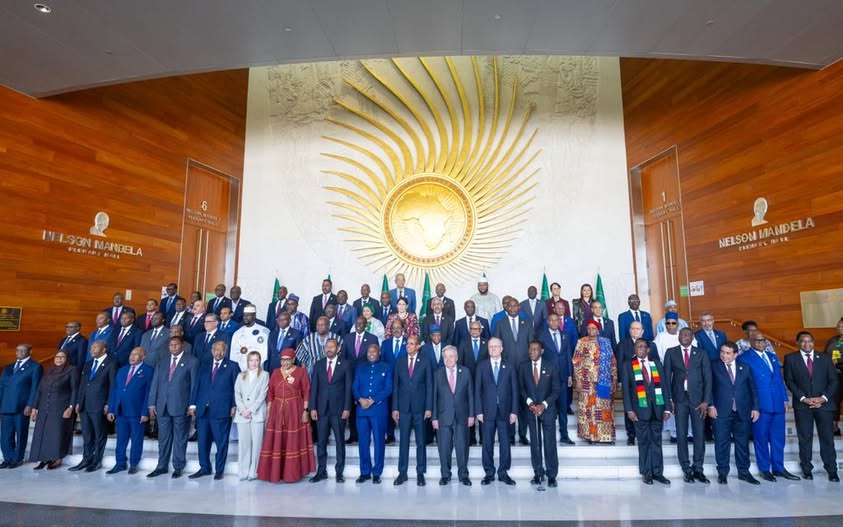
At the 39th Ordinary Session of the African Union Assembly, President John Dramani Mahama reaffirmed Africa’s unified push for reparatory justice, underscoring his mandate as the African Union Champion on Reparations and outlining Ghana’s diplomatic roadmap toward a landmark resolution at the United Nations General Assembly.
AU Mandate for Justice in 2025
In February 2025, the Assembly of Heads of State and Government adopted Decision 884, declaring 2025 as the Year of Justice for Africans and People of African Descent through Reparations. Reparations for the transatlantic slave trade, colonialism and apartheid were designated as a flagship priority of the Union. Following that decision, President Mahama was entrusted with the responsibility of serving as the AU Champion on Reparations. Addressing journalists at the AU Summit press conference, he described the role as a solemn obligation to pursue truth, recognition and justice for past and future generations.
At the 80th Session of the UN General Assembly in September 2025, Mahama announced Ghana’s intention to lead the tabling of a resolution declaring the trafficking in enslaved Africans and racialized chattel enslavement as the gravest crime against humanity. The initiative has since moved into what he termed a structured diplomatic and legal process.
Legal Foundation and Continental Consensus
According to President Mahama, the draft resolution is grounded firmly in international law, particularly the prohibition of slavery as a peremptory norm from which no derogation is permitted. The text rests on three pillars: historical accuracy, legal defensibility and alignment between Africa and the diaspora.
Ghana established a high level committee under its Ministry of Foreign Affairs to coordinate consultations and refine the legal framework. Engagements have included UNESCO, Pan African legal experts, AU committees and diaspora representatives. The Assembly adopted the initiative by consensus at the recent summit, giving Ghana a unified continental mandate. The resolution’s refined title reads: “Declaration of the Trafficking in Enslaved Africans and Racialized Chattel Enslavement of Africans as the Gravest Crime Against Humanity.” President Mahama emphasized that precision in language strengthens the case for justice.
Implementation Mechanisms and Legal Pathways
Beyond diplomatic endorsement, President Mahama underscored that the time has come to operationalise reparatory justice through concrete institutional mechanisms. He noted that the first steps toward implementation have already been taken with the strengthening of the African Union Commission of Experts on Reparations and the AU Legal Experts Reference Group. These bodies are mandated to refine legal strategy, design practical frameworks and explore structured pathways toward accountability. The inclusion of seasoned legal professionals signals preparedness for potential litigation and formal claims processes where necessary, should consensus diplomacy require reinforcement. According to Mahama, building these mechanisms ensures that the reparations agenda moves from moral affirmation to actionable legal and institutional engagement.
Africa and CARICOM Speaking with One Voice
President Mahama confirmed extensive consultations with Caribbean partners ahead of the 50th Meeting of the CARICOM. He stated that Africa and the Caribbean are now speaking with one voice on reparatory justice. From 20 February 2026, Ghana will undertake intensive diplomatic engagements in New York with CARICOM, the Non Aligned Movement, the Group of 77 and China, the European Union and other regional groupings. The resolution is expected to be formally tabled at the UN General Assembly on 2 March 2026, the International Day of Remembrance of the Victims of Slavery and the Transatlantic Slave Trade.
Beyond Monetary Compensation
Responding to questions on the quantum of reparations, President Mahama clarified that the current resolution does not focus on financial figures. He stressed that reparations extend beyond monetary compensation. They include setting the historical record straight, addressing structural inequalities and pursuing restitutive justice such as the return of stolen cultural artifacts. He noted that while scholarly research has attempted to estimate the economic value of displacement and exploitation, the immediate objective is international recognition of the crime and its enduring consequences.
A Turning Point for Africa
Linking the reparations initiative to broader geopolitical shifts, President Mahama argued that the global multilateral order is under strain. He referenced Africa’s experience during the COVID 19 pandemic as evidence that the continent must take greater ownership of its destiny. He reiterated that Africa cannot remain passive amid declining development assistance and shifting global priorities. The reparations agenda, he suggested, forms part of a broader strategy to reposition Africa within an evolving global order.
The Role of the Pan African Progressive Front
The Pan-African Progressive Front has welcomed the AU consensus and reaffirmed its commitment to advancing reparatory justice through research, international advocacy and movement building.
As a platform dedicated to Pan African solidarity and progressive transformation, PPF continues to:
- Support diplomatic efforts with the African Union, CARRICOM and other regional blocs
- Promote scholarship and public education on the cultural, economic and legal dimensions of reparations
- Strengthen collaboration between African and diaspora institutions
- Advocate for restitution of looted cultural property and structural redress
PPF has engaged civil society networks, legal scholars and international partners to ensure that reparations remain a central pillar of Africa’s global engagement strategy in 2026 and beyond. The adoption of the resolution at the UN General Assembly would not conclude the reparations movement. It would mark a foundational step toward sustained dialogue, policy formulation and structured negotiations.
As President Mahama stated, acknowledgment is the first step toward justice. With a continental mandate and growing diaspora alignment, Africa’s case for reparatory justice now advances with renewed clarity and collective resolve.