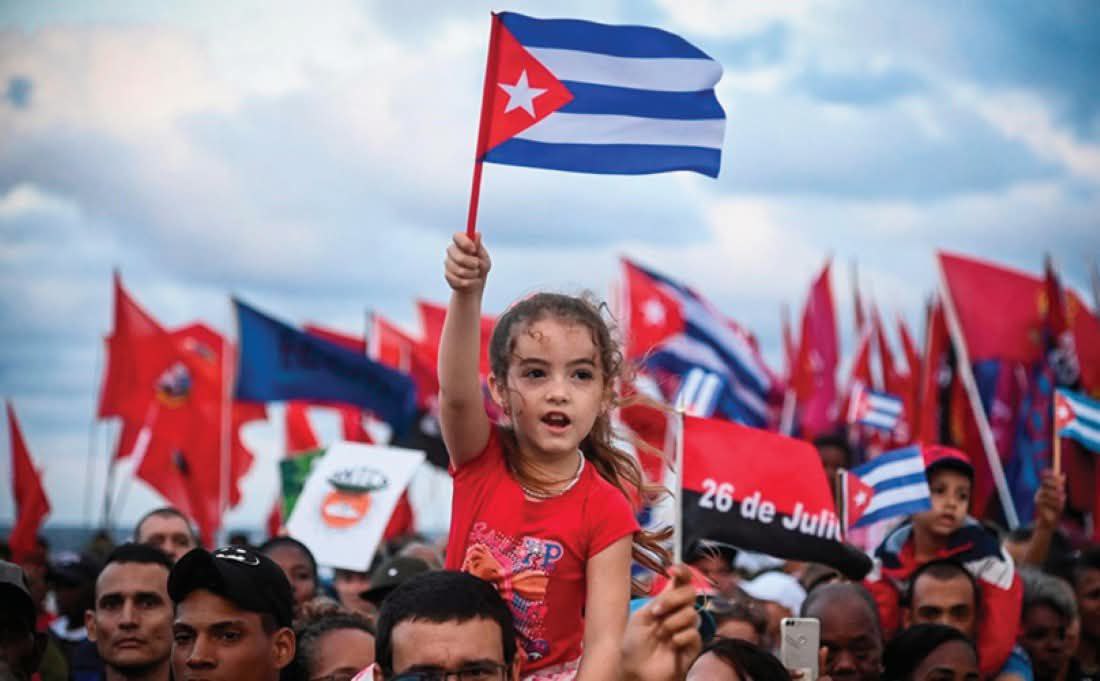
On 19 February 2026, the Pan-African Progressive Front (PPF), together with its allied progressive forces, issued a joint declaration demanding the immediate end to the United States economic blockade against the Republic of Cuba, describing it as a prolonged act of economic coercion that violates international law and undermines the sovereignty of a small island nation.
The statement, endorsed by organisations committed to social justice, anti-colonial struggle and South–South solidarity, characterises the blockade as a unilateral measure that has persisted for more than six decades. The U.S. embargo on Cuba was first imposed in 1960 following the Cuban Revolution and later codified into law through the Helms-Burton Act of 1996. That legislation expanded the embargo’s reach by introducing extraterritorial provisions affecting third-country entities engaged in trade with Cuba.
According to the joint statement, these provisions discourage financial institutions, shipping companies and corporations from maintaining lawful commercial relations with Cuba due to the risk of secondary sanctions. The coalition argues that such measures extend beyond bilateral policy and function as a broader mechanism of economic pressure within the international financial system.
The signatories also raised concern over Cuba’s designation by the United States as a “State Sponsor of Terrorism.” They contend that the listing intensifies financial isolation by restricting access to international banking channels, deterring foreign investment and complicating routine commercial transactions. The coalition maintains that the cumulative effect of these restrictions exacerbates economic strain within Cuba.
At the multilateral level, the United Nations General Assembly has, since 1992, adopted annual resolutions calling for an end to the U.S. embargo against Cuba. In successive votes, an overwhelming majority of member states have supported lifting the blockade. The PPF and its allied forces highlight this pattern of international opposition as evidence of sustained global rejection of the policy.
Beyond contemporary geopolitics, the declaration situates Cuba within a broader historical context of international solidarity. During the armed conflict in Angola (1975–1991), Cuba deployed military personnel in support of the Popular Movement for the Liberation of Angola (MPLA). The Battle of Cuito Cuanavale is widely regarded as a pivotal confrontation in the regional struggle involving Angola, apartheid South Africa and allied forces. Former South African President Nelson Mandela publicly acknowledged Cuba’s contribution to the independence of Namibia and the broader anti-apartheid struggle.
The statement also recalls Cuba’s medical internationalism, particularly during the COVID-19 pandemic, when Cuban medical brigades were dispatched to multiple countries across Africa, Latin America, Europe and the Caribbean. Despite economic constraints, Cuban research institutions developed domestic COVID-19 vaccines, underscoring the country’s capacity for scientific mobilisation under restrictive conditions.
In their concluding demands, the PPF and its allied forces call for the complete and unconditional lifting of the economic, commercial and financial blockade; the removal of Cuba from the U.S. terrorism list; and the rejection of sanctions as instruments of regime change. They further urge governments and parliaments worldwide to oppose extraterritorial sanctions and to safeguard lawful trade relations under international law.
Framing the issue within Pan-Africanist and anti-colonial traditions, the coalition argues that normalising economic siege as a policy tool risks eroding the sovereignty of all nations, particularly those in the Global South. They reaffirm support for diplomatic engagement and multilateral mechanisms as the legitimate means of resolving disputes between states.
The full joint statement is attached and available in English, French, Portuguese and Spanish.
FR-COMMUNIQUÉ DE PRESSE (AFRIQUE SANS FRONTIÈRES)
JOINT STATEMENT BY PROGRESSIVE FORCES (CUBA) (1)