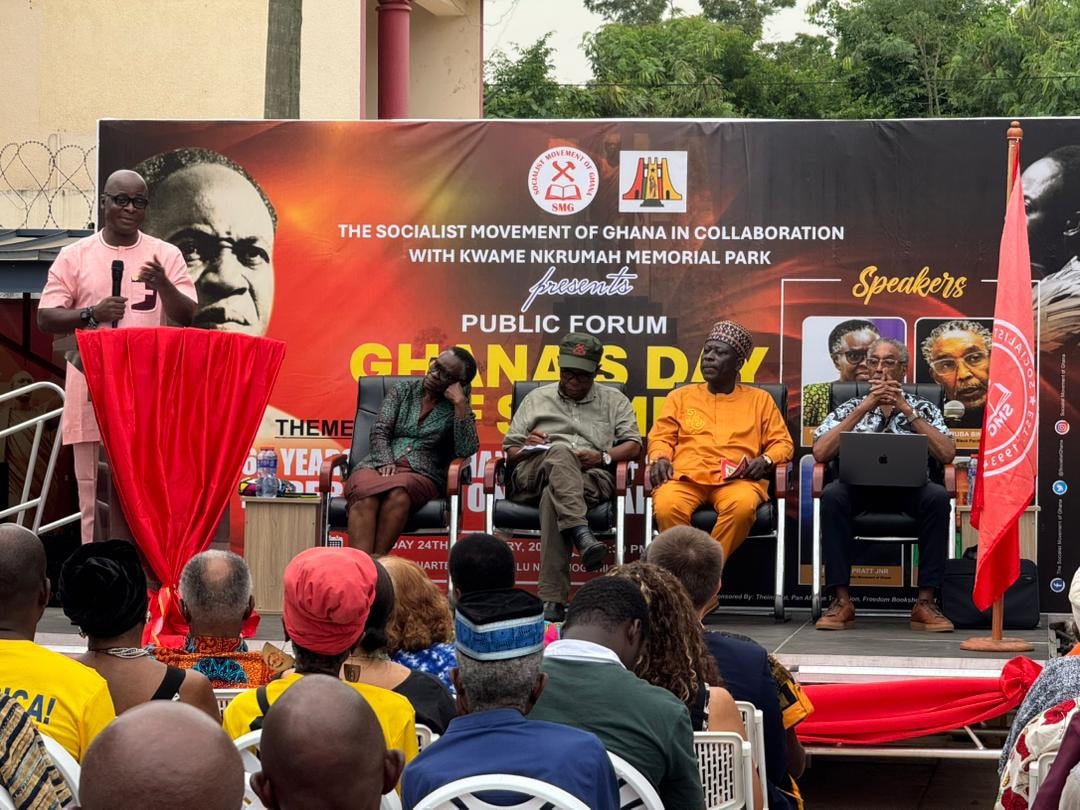
The Pan-African Progressive Front took part in a public forum organized by the Socialist Movement of Ghana in Accra on 24th February 2026 to mark sixty years since the overthrow of Kwame Nkrumah. The event, held under the theme “Ghana’s Day of Shame: 60 Years After Ghana’s Day of Shame, Imperialism on the Rampage,” brought together activists, students, scholars and members of the public to reflect on the coup of 24 February 1966 and its lasting impact. The Socialist Movement of Ghana, a key ally of PPF, organized the forum as part of its political education work. Speakers examined the historical background of the coup and warned that foreign interference in African politics did not end in 1966.
Participants described the coup as an attack on Ghana’s sovereignty. They argued that Nkrumah’s government was removed because it pursued independent development, state-led industrialization and Pan-African unity. His policies aimed to free Ghana and Africa from economic dependence on former colonial powers. According to speakers, the coup reversed this direction and opened the door to renewed Western influence.
The discussion also referred to declassified documents about the role of the CIA. Speakers noted that U.S. officials viewed Nkrumah’s policies as a threat to their strategic and economic interests during the Cold War. For many at the forum, this confirmed that the coup must be understood within a broader pattern of imperial intervention.
The forum connected Ghana’s history to present global struggles. Speakers condemned what they called U.S. aggression against Venezuela, pointing to sanctions and kidnapping as tools used to weaken governments that resist U.S. influence. The long-standing blockade on Cuba was described as unjust and harmful strangulation of the ordinary people. African states were called upon to stand in solidarity with Cuba by supplying the country with the oil it critically needs to survive, thereby challenging the ongoing blockade illegal imposed on Cuba.
Participants also spoke about the siege and humanitarian crisis in the Gaza Strip. Some compared current external so called “peace plans” on Palestine to the logic of the Berlin Conference, where powerful states made decisions over African lands without African consent.
Speakers also strongly condemned remarks made by Marco Rubio at the recent Munich Security Conference, particularly his comments on Africa. They described his framing of the continent as a battleground for great power competition as arrogant and colonial in tone. According to speakers, reducing Africa to a strategic arena for U.S. rivalry with other powers denies African agency and reinforces the old logic that external forces have the right to define the continent’s future. They argued that such language reflects a continued mindset of control rather than respect for African sovereignty and self determination.
The Pan-African Progressive Front expressed its solidarity with the event and its clear rejection of imperialism in all its forms. PPF reaffirmed its commitment to African sovereignty, Pan-African unity and resistance to foreign domination.