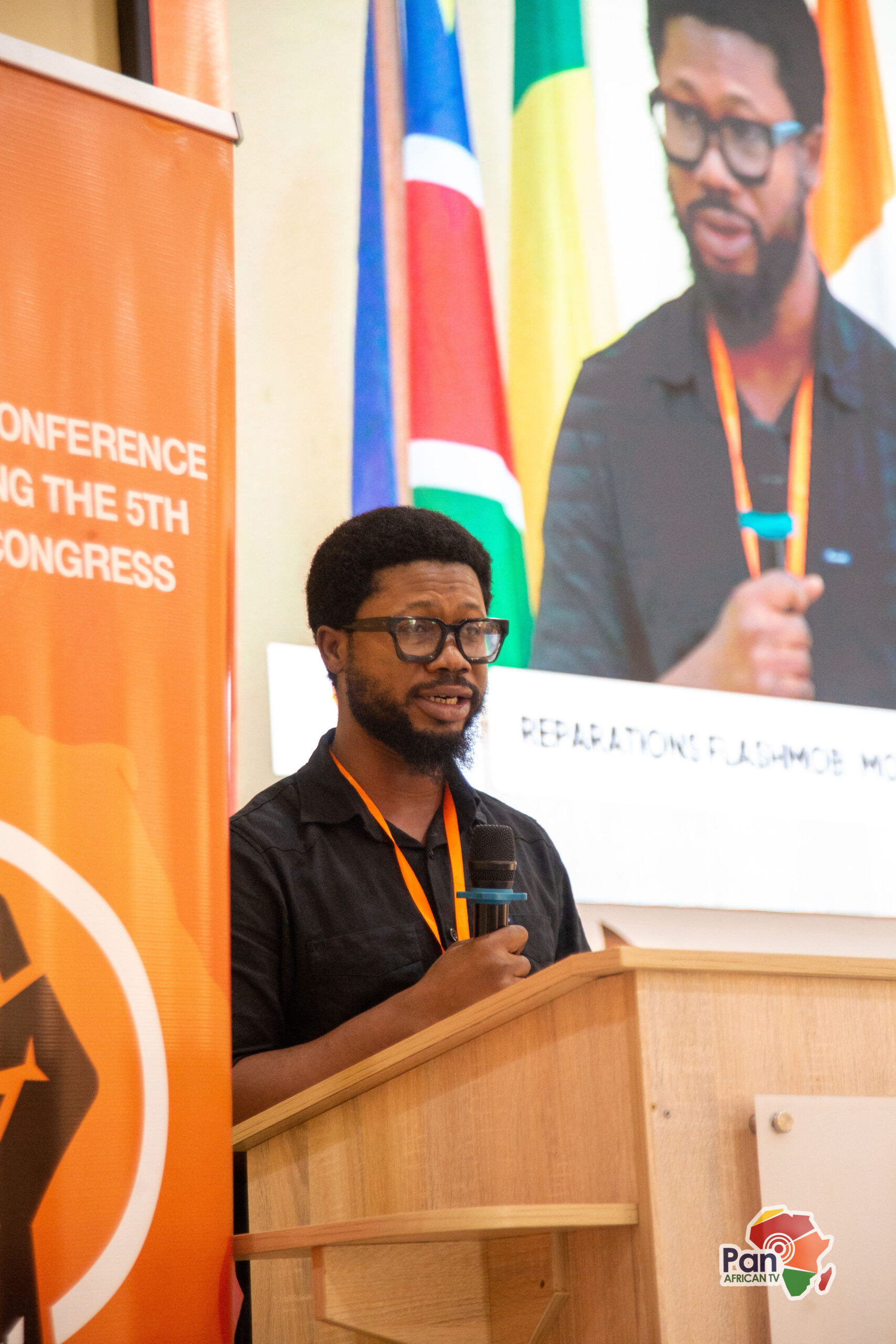
Amid the calls for debt cancellation and colonial accountability that defined the Youth Forum on Debt and Reparations, one address stood apart for its willingness to complicate the room's own consensus. Speaking on behalf of the Socialist Movement of Ghana, Comrade Blaise Tulo delivered a sharp, theoretically rigorous intervention that pushed participants to confront a question few reparations conversations dare ask directly: what, precisely, is the political vehicle capable of carrying this struggle to its conclusion?
A Movement in the Tradition of Manchester
Blaise Tulo opened by placing PPF's work within the direct lineage of the 1945 Fifth Pan-African Congress, describing that gathering not as ceremony but as a congress of "organised militants, trade unionists, students, workers, activists" who resolved that colonialism must end, not merely be reformed. That the Pan-African Progressive Front now carries that torch into a moment of compounding global crises, Blaise Tulo told participants, "is a political statement in itself," extending fraternal greetings and full solidarity from the Socialist Movement of Ghana.
Reclaiming a Stolen Word
The address's central provocation came early: reparations, Blaise Tulo argued, "is a word that has been stolen," laundered through diplomatic communiqués and packaged into language safe for multilateral institutions but harmless to capital. True reparatory justice, in this framing, is not a cheque transferred between governments. It is the restoration of African peoples' capacity to determine their own economic destiny, which means confronting the class structures that make exploitation possible, both between Africa and the world and within African societies themselves.
Tracing that exploitation from the transatlantic slave trade's role in financing European industrialisation, through colonial-era resource extraction, to today's debt traps and structural adjustment programmes, Blaise Tulo insisted these were not separate injustices but a single, continuous process, one that concentrated international capital continues to benefit from while the African working class, the peasantry, and unemployed youth continue to bear its cost.
Lessons from Nepal and Kenya
The speech's most striking section drew on two recent global youth uprisings to make a pointed argument about organisation. In Nepal's 2006 uprising, Blaise Tulo noted, extraordinary youth mobilisation ultimately gave way to a peace process managed by international NGOs and a political settlement that left underlying production relations untouched. In Kenya's 2024 Gen Z protests, a finance bill was defeated and a government humiliated, yet within months the same debt architecture remained in place and many protest leaders found themselves without a political home capable of converting street energy into lasting structural power.
"Youth is not a social class," he reminded the Forum. "Youth is a demographic condition." That condition makes young people an explosive political force, but explosive forces require an organisational container or their energy dissipates without structural impact. The lesson drawn was direct: youth energy channelled through trade unions, socialist parties and peasant movements becomes a sustained force capable of contesting production relations themselves; youth energy left autonomous is, historically, energy that capital and the state have proven able to absorb, fragment, or simply outlast.

A Concrete Programme, Not Just a Critique
Rather than leaving the analysis abstract, Blaise Tulo offered participants gathered a practical organising programme across the terrain of African youth life. On campuses, student unions should function as schools of political education linking campus struggles over fees and accommodation directly to the reparations demand. In communities, organising must extend beyond universities to reach working-class youth often left out of elite reparations discourse. In the informal economy, where most of Africa's working class is employed, savings cooperatives and neighbourhood committees were named as legitimate sites of political education. On social media, Blaise Tulo drew a sharp distinction between virality and organisation: "A hashtag that trends and then fades is Kenya 2024. A movement that trends and then deepens into union membership and socialist organisation is something else entirely." Micro-lawsuits and legal activism, a mechanism central to the Forum's own second session, were welcomed as useful flanking tactics, but Blaise Tulo cautioned that legal victories without organised social power remain precarious, since courts ultimately reflect the balance of class power rather than override it.
An International and Internally Honest Struggle
Blaise Tulo closed the international section of the address by calling for organised solidarity between African working-class movements and their counterparts across the Global South and North alike, rejecting any framing that pits ordinary workers in Europe against African peoples as a divide-and-rule narrative serving capital. He was equally direct about accountability closer to home, warning that reparations cannot mean transferring resources from European governments to African elites who would use them to deepen domestic inequality.
Inheriting Unfinished Business
In closing, Blaise Tulo returned to Manchester: the 1945 Congress was right that colonialism must end, and it did end in its formal sense, but the deeper struggle for economic and political self-determination remains unfinished business inherited by the present generation, now obscured by what he called a thicker "ideological fog" of development and governance language. The task, he told participants, is to build patient, serious, organised working-class movements capable of carrying the reparations struggle forward as a living political force rather than a recurring conference agenda item.
"The Socialist Movement of Ghana stands with you," he told the Forum in closing. "The struggle continues. The class struggle continues. And reparatory justice, genuine, material, transformative reparatory justice, remains our horizon."
— Pan-African Progressive Front